
Key messages
Why is it important?
Most Aboriginal and Torres Strait Islander (First Nations) children grow up in safe and supportive environments. However, they are over-represented in the child protection system. This over-representation reflects systemic inequities and racism linked to colonial history and the legacy of past policies of forced child removal, intergenerational trauma, poverty, housing instability, family violence, substance use, and lack of culturally safe services. The Aboriginal and Torres Strait Islander Child Placement Principle aims to maintain children’s connections to family, culture, and Country, but barriers such as limited kinship carers and inconsistent application of the principle continue. Trauma-informed, culturally responsive, community-led approaches are needed. The National Agreement on Closing the Gap has identified the importance of reducing the over-representation of First Nations children in the child protection system (including Target 12 which focuses on out-of-home care) in order to direct policy attention and monitor progress.
Data findings
- In 2023–24, First Nations children aged under 18 were about 7 times as likely as non-Indigenous children to receive child protection services (146 per 1,000 First Nations children and 21 per 1,000 non-Indigenous children).
- Nationally, in 2023–24, among First Nations children who were the subject of substantiated maltreatment, the most common primary type of maltreatment was emotional abuse (51% of substantiated notifications, or 6,659), followed by neglect (29% or 3,798), physical abuse (11% or 1,447) and sexual abuse (7.8% or 1,007).
- Over the period from 2019–20 to 2023–24, the rate of substantiated maltreatments among First Nations children (aged under 18) decreased nationally, with rates declining from 38 per 1,000 children in 2019–20 to 33 per 1,000 children in 2023–24. The rate of substantiated maltreatments for non-Indigenous children also decreased during this period, while the gap between these rates remained similar.
- Across jurisdictions, there was no statistically significant change in substantiated maltreatments for First Nations children in any jurisdiction except New South Wales, where rates of First Nations children who were the subjects of substantiated maltreatments decreased from 42 to 30 per 1,000 children over the period.
- Over the period from 30 June 2020 to 30 June 2024, there was not a statistically significant change in the rate of First Nations children on care and protection orders, with the rate ranging from 61 to 63 per 1,000 children. Over the same period, the rate for non-Indigenous children decreased significantly from 7.1 to 6.4 per 1,000 children.
- There was a statistically significant increase in rates of care and protection orders for First Nations children in Queensland (17% increase), South Australia (14% increase) and Tasmania (15% increase). The Northern Territory was the only jurisdiction reporting a significant decrease in this rate (14% decrease).
- At 30 June 2024, 45% of children in out-of-home care were First Nations children (19,987 of 44,792, where Indigenous status was known). Of the First Nations children in out-of-home care, almost two-thirds (63% or 12,629) were living with First Nations or non-Indigenous relatives or kin or other First Nations caregivers.
- Between 30 June 2020 and 30 June 2024, the rate of out-of-home care among First Nations children did not change significantly, ranging from 49 per 1,000 children in 2020 to 50 in 2024, while the rate among non-Indigenous children decreased from 5.2 to 4.6 per 1,000 children.
- Over three-quarters (76% or 3,489) of the 4,575 First Nations children who were under some type of youth justice supervision during 2022–23 came into contact with the child protection system in the 10 years prior. In contrast, 55% of non-Indigenous young people under youth justice supervision came into contact with the child protection system during the same 10-year period.
- Out-of-home care is viewed as an intervention of last resort, and the preference is always for children to be reunited with their parents if possible. Many children can be safely reunited with their families when their families receive appropriate supports and interventions. In 2023–24, 13% of the 10,509 First Nations children aged 0–17 in out-of-home care (excluding children on long-term guardianship orders) were reunified during the year, compared with 18% of non-Indigenous children. Of 1,601 First Nations children aged 0–16 who were reunified with family during 2022–23, 85% did not return to out-of-home care within 12 months, compared with 88% for non-Indigenous children.
Research and evaluation findings
- Inquiries in Victoria and South Australia indicate that notifications to child protection authorities about unborn children are more common for First Nations families than for non-Indigenous families and are increasing.
- A study in Central Australia of the Australian Nurse-Family Partnership Program found that children of young (aged under 20) and first-time mothers enrolled in the program had lower rates of involvement with child protection.
- Families participating in the Birthing in Our Community program had significantly lower odds of newborns being removed at birth compared with those receiving standard care, and Birthing on Country models have been shown to be more cost-effective than standard care, reinforcing the benefits of culturally safe, First Nations-led approaches for both health and child protection outcomes.
- The Queensland Government’s Keeping Families Together (KFT) Supporting Housing pilot project provided secure and affordable housing for 20 families along with intensive and holistic family supports. Stable housing positively impacted overall family wellbeing. Families participating in KFT also experienced reduced child protection intervention, with both families and child support officers framing KFT as a protective factor.
- Victorian trials of 3 First Nations-led child protection diversion programs achieved high success rates in diverting children from statutory intervention, with culturally grounded practices and strong partnerships identified as critical success factors.
- Barriers to implementing the Aboriginal and Torres Strait Islander Child Placement Principle include a shortage of First Nations foster and kinship carers, limited support for kinship carers, and inconsistent application across states and territories, making it harder to keep children connected to family, culture, and Country.
Implications
Australian governments have committed to ensuring First Nations children grow up safe, connected, and supported in their families, communities, and cultures. Yet First Nations children remain significantly over-represented in child protection systems; as such, this is a focus of the National Agreement on Closing the Gap. Reducing over-representation requires structural reforms to address systemic bias and racism in the child protection system across states and territories; and also investment in culturally safe, community-led prevention and early intervention. The establishment of the National Commission for Aboriginal and Torres Strait Islander Children and Young People to promote and protect the rights of First Nations children and young people, provide advice to Government, and enhance coordination across Australia reinforces the commitments made by the Australian Government and states and territories. Strengthening Aboriginal Community-Controlled Organisations, improving data quality, and embedding First Nations leadership across systems are essential to transforming outcomes and ensuring children can thrive in safe, culturally connected environments.
Why is it important?
The majority of Aboriginal and Torres Strait Islander (First Nations) children are being raised in safe and healthy environments, where their families teach them to be active contributors to family and community life. These children are nurtured within rich and supportive familial and cultural environments (Lohoar et al. 2014; Martin and Walter 2017). However, First Nations children are also disproportionately over-represented at every stage of the child protection system.
Interactions with the child protection system for First Nations children must be understood within the context of colonialism and systemic racism that First Nations communities have survived. This history includes significant trauma from dispossession of land, removal of children, family separation and displacement, and loss of kin, culture and Country (SNAICC et al. 2023; The Australian Human Rights and Equal Opportunity Commission 1997).
These removal policies have resulted in long-term social, physical and psychological effects on individuals, families and communities (Atkinson 2013; Thurber et al. 2021). Child protection issues remain critical for the First Nations population, as the history of trauma and related stressors has impacted parents, their children, and communities (Darwin et al. 2023). Systemic failures by governments to address the structural drivers of child protection involvement – such as poverty, inter-generational trauma, under-investment in service provision, and lack of culturally safe services – are also key factors in the contact of First Nations children with the child protection system (AHRC 2015; CACYP 2024; de Bortoli et al. 2015).
Addressing these issues requires culturally appropriate strengths-based support services for families and children such as those offered by community-controlled organisations, as well as self-determination, and strong policy support to ensure better outcomes for First Nations children and communities (SNAICC et al. 2023). Empowering First Nations communities through self-determination and holistic, culturally-responsive, wrap-around welfare services can repair historical harm and promote sovereignty of First Nations communities (The Australian Human Rights and Equal Opportunity Commission 1997). First Nations-led models, such as the Victorian Aboriginal Child and Community Agency’s Nugel (Woiwurrung for ‘belong’) program, show that community-controlled approaches achieve better reunification, stronger cultural connections, and reduced re-entry into child protection (McDonald et al. 2025; VACCA 2025).
Experience of maltreatment (physical, emotional and psychological abuse, neglect, sexual abuse, and witnessing family violence) during childhood has serious and long-term effects on social and emotional wellbeing and health (Emerson et al. 2015; Thurber et al. 2021). There is also a link between out-of-home care, juvenile justice, and the over-incarceration of First Nations people in the criminal justice system (The Australian Human Rights and Equal Opportunity Commission 1997). Children and young people who have been abused or neglected are at greater risk of engaging in criminal activity and of entering the youth justice system (AIHW 2019b).
In responding to situations in which First Nations children are at risk, all states and territories have adopted the Aboriginal and Torres Strait Islander Child Placement Principle (ATSICPP). The fundamental goal of the ATSICPP is to enhance and preserve First Nations children’s connection to family and community, and their sense of identity and culture. The ATSICPP recognises the importance of connections to family, community, culture and Country in child and family legislation, policy, and practice, and emphasises the importance of self-determination in supporting and maintaining those connections (Burton et al. 2018). When First Nations children are removed from their family, the ATSICPP requires the following order of preference for their placement: with First Nations relatives or extended family members, or other relatives or extended family members, First Nations members of the child’s community, First Nations family-based carers, a non-Indigenous carer or in a residential setting (SNAICC 2019). Barriers to this principle being applied include a shortage of foster and kinship carers, issues of support for kinship carers and inconsistency in child protection decision-making (Arney et al. 2015; Chamberlain et al. 2022; Healy et al. 2023; Kiraly and Humphreys 2016).
Supporting community-led initiatives and self-determination is essential. The Wiyi Yani U Thangani Report (2020) by the Australian Human Rights Commission (AHRC) emphasised the importance of culturally safe child protection services. This includes training for workers on First Nations cultures and histories and ensuring accountability for authorities (AHRC 2020). Holistic approaches to child protection should address the physical, emotional, spiritual, and cultural wellbeing of First Nations children. Integrating traditional healing practices and community-based support systems, alongside strong culturally co-designed policy and legislative frameworks, is essential for the effective implementation of the ATSICPP and other protective measures. Successful programs demonstrate the potential for positive change, while First Nations led data collection and research ensure that policies remain evidence-based and responsive to the needs of First Nations communities (SNAICC et al. 2024).
Some of these priorities are reflected in the National Agreement on Closing the Gap (the National Agreement), developed in partnership between Australian governments and the Coalition of Aboriginal and Torres Strait Islander Peak Organisations. The National Agreement has been built around 4 Priority Reforms that have been directly informed by First Nations people. These reforms are central to the National Agreement and will change the way governments work with First Nations people, including through working in partnership and sharing decision making, building the Aboriginal community-controlled sector, transforming government organisations, and sharing access to data and information by First Nations communities. The National Agreement has identified the importance of reducing the over-representation of First Nations children in the child protection system. To support this outcome the National Agreement specifically outlines the following target to direct policy attention and monitor progress:
- Target 12: By 2031, reduce the rate of over-representation of Aboriginal and Torres Strait Islander children (0–17 years old) in out-of-home care by 45 per cent.
Furthermore, within the National Agreement, ‘rates of First Nations children entering out-of-home care and receiving protection orders, where family violence is indicated’ has been identified as a driver of Outcome 13 (Aboriginal and Torres Strait Islander families and households are safe).
For the latest data on the Closing the Gap targets, see the Closing the Gap Information Repository.
Data findings
In Australia, state and territory governments are responsible for statutory child protection. All jurisdictions have legislative requirements on the mandatory reporting of suspected child abuse. Each jurisdiction has its own legislation, policies and practices in relation to child protection (AIHW 2024, 2025b; Guthridge et al. 2014). Relevant departments provide support when child protection services have deemed that children:
- have been, or are at risk of being abused, neglected, or otherwise harmed, and
- have parents who are unable to provide adequate care or protection (AIHW 2025a).
Nationally, in 2023–24, 57,789 First Nations children came into contact with the child protection system – corresponding to a rate of 146 per 1,000 First Nations children receiving child protection services (Table 2.12-1). This includes children who were subjects of investigation for alleged maltreatment, were on care and protection orders and/or were in out-of-home care (see Box 2.12.1).
Table 2.12-1 Number and rate of First Nations children in the child protection system, by state and territory
|
State and territory |
Children receiving child protection services, 2023–24 |
Children who were the subjects of substantiated maltreatment, 2023–24 |
Children placed on care and protection orders, 30 June 2024 |
Children in out-of-home care, 30 June 2024 |
|---|---|---|---|---|
|
Number |
|
|
|
|
|
New South Wales |
15,367 | 4,116 | 8,222 | 6,312 |
|
Victoria |
8,387 | 2,113 | 3,541 | 2,869 |
|
Queensland |
16,095 | 2,584 | 6,363 | 4,961 |
|
Western Australia |
8,573 | 2,186 | 3,389 | 2,766 |
|
South Australia |
4,047 | 1,002 | 1,885 | 1,744 |
|
Tasmania |
827(a) | 146 | 547 | 395(a) |
|
Australian Capital Territory |
592 | 102 | 285 | 190 |
|
Northern Territory |
3,901 | 716 | 789 | 750 |
|
Total |
57,789 | 12,965 | 25,021 | 19,987 |
|
Rate (per 1,000 children) |
|
|
|
|
|
New South Wales |
110.3 | 29.5 | 58.8 | 45.1 |
|
Victoria |
266.1 | 67.0 | 111.8 | 90.6 |
|
Queensland |
140.4 | 22.5 | 55.1 | 42.9 |
|
Western Australia |
181.5 | 46.3 | 71.5 | 58.3 |
|
South Australia |
192.9 | 47.7 | 89.7 | 83.0 |
|
Tasmania |
63.6(b) | 11.2 | 42.2(b) | 30.4(b) |
|
Australian Capital Territory |
172.2 | 29.7 | 82.9 | 55.3 |
|
Northern Territory |
154.8 | 28.4 | 31.4 | 29.9 |
|
Total |
146.1 | 32.8 | 63.0 | 50.3 |
(a) Tasmania data exclude children not under care and protection orders placed with relatives for whom a financial contribution is made under the Supported Extended Family or Relatives Allowance programs. Tasmania is not able to include children in care where a financial payment was offered but was declined by the carer meaning Tasmania’s data may be lower than would be the case if the counting rule was strictly applied.
(b) Due to issues with the recording of order status, Tasmanian data for care and protection orders should be interpreted with caution.
Notes
1. Data presented in this table are not comparable across jurisdictions due to differences in the way jurisdictions collect and report data on notifications, investigations, and substantiations, and differences in the proportion of children with an unknown Indigenous status at investigation
2. See corresponding source tables for additional notes.
Source: Tables D2.12.3, D2.12.7, D2.12.12, and D2.12.18.
Substantiated maltreatments
Notifications, investigations, and substantiations are the entry point for children into the child protection system. These components are sequential:
- an initial notification of alleged child maltreatment is made to a child protection department (notifications)
- if the notification meets the threshold for further action, an investigation of the alleged maltreatment is conducted (substantiations)
- the investigation ends with a substantiation decision about whether there is reasonable cause to believe that a child has been, is being, or is at risk or significant risk of being, maltreated (substantiated maltreatments).
This section relates to substantiated maltreatments.
Nationally, in 2023–24, there were 12,965 (33 per 1,000) First Nations children who were the subjects of substantiated maltreatments, meaning an investigation has determined there is reasonable cause to believe that a child has been, is being, or is at risk or significant risk of being maltreated (Table D2.12.2, Table D2.12.3).
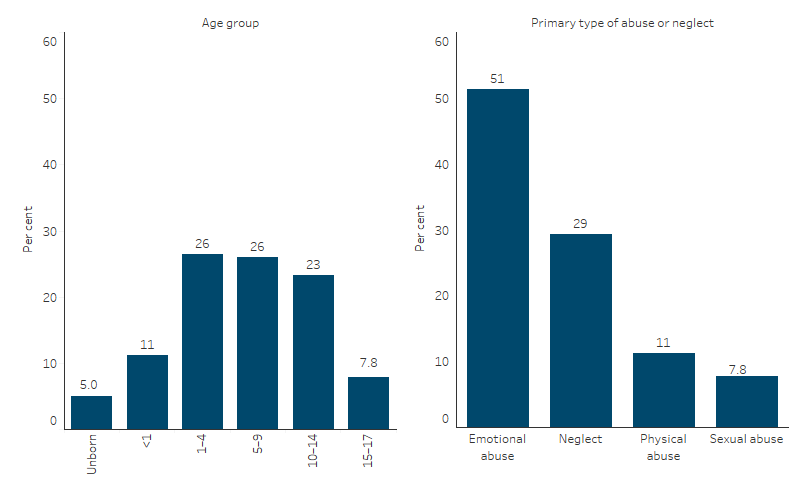
Of the 12,965 substantiated maltreatments for First Nations children aged 0–17:
- 650 (5.0%) were for unborn children
- 1,445 (11%) were for children aged under 1
- 3,421 (26%) were for children aged 1–4
- 3,370 (26%) were for children aged 5–9
- 3,027 (23%) were for children aged 10–14
- 1,017 (7.8%) were for children aged 15–17 (Figure 2.12.1, Table D2.12.2).
Nationally, in 2023–24, among First Nations children who were the subject of substantiated maltreatment, the most common primary type of maltreatment was:
- emotional abuse, reported for 51% (6,659) of substantiated notifications, followed by
- neglect (29% or 3,798)
- physical abuse (11% or 1,447)
- sexual abuse (7.8% or 1,007) (Figure 2.12.1, Table D2.12.4).
Figure 2.12.1: First Nations children who were the subjects of substantiated maltreatments, by age group, and by primary type of maltreatment, 2023–24
Source: Tables D2.12.2 and D2.12.4. AIHW Child Protection Collection 2023–24.
Care and protection orders
Care and protection orders are legal orders or arrangements that give child protection departments partial or full responsibility for a child’s welfare (AIHW 2025a). Children are placed on care and protection orders if they have been seriously harmed, are at risk or significant risk of harm or there are no other care options. In most cases this occurs following a substantiated maltreatment notification, and orders can be made to remove children from allegedly unsafe environments. Child protection departments can also pursue other options – for example referring the family to support services or putting a safety plan in place – in cases where parents have made changes to ensure children’s safety and wellbeing at home.
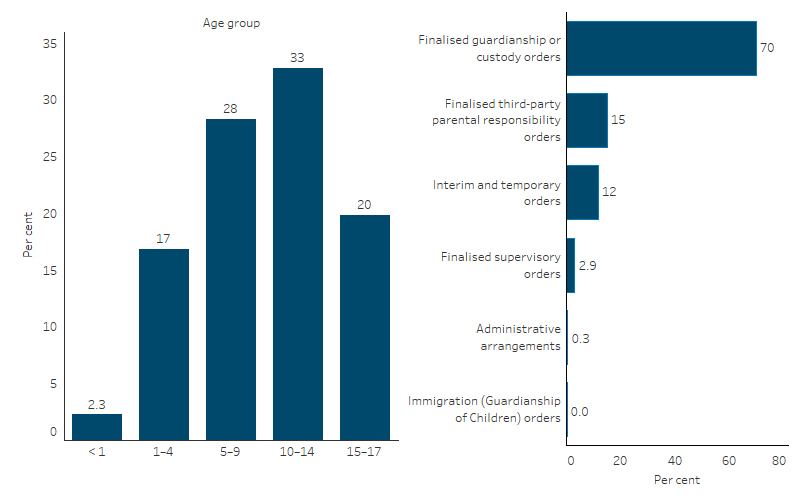
Nationally, at 30 June 2024, 25,021 First Nations children were on care and protection orders. This corresponds to a rate of 63 per 1,000 children. At 30 June 2024, 19% of First Nations children on care and protection orders were aged under 5, 28% were aged 5–9, 33% aged 10–14, and 20% were aged 15–17 (Figure 2.12.2, Table D2.12.6, Table D2.12.7).
Of the 25,021 First Nations children who were on care and protection orders, 70% (17,472) were on finalised guardianship or custody orders, 15% (3,802) were on finalised third-party parental responsibility orders and 12% (2,954) were on interim or temporary orders (Figure 2.12.2, Table D2.12.8).
Figure 2.12.2: First Nations children on care and protection orders, by type of care and protection order, and by age group, 30 June 2024
Source: Table D2.12.6 and D2.12.8. AIHW Child Protection Collection 2023–24.
There are different types of orders available across jurisdictions, and different policies and practices putting them into effect, so care should be taken when making comparisons across jurisdictions. Noting this, across jurisdictions, rates of care and protection orders ranged from 31 per 1,000 children (in the Northern Territory) to 112 per 1,000 children (in Victoria) (Table D2.12.7).
At 30 June 2024, finalised guardianship or custody orders were the most common type of all care and protection orders across all jurisdictions, ranging from 57% (in Victoria) to 87% (in the Northern Territory) (Table D2.12.8).
Of First Nations children who were the subject of substantiations in 2022–23, 23% (3,602) were subsequently placed on a care and protection order within 12 months. This differed across the jurisdictions, ranging from 7% in the Northern Territory to 38% in Victoria (Table D2.12.16).
Out-of-home care
A nationally consistent definition for out-of-home care was implemented in 2018–19 (AIHW 2023). Out-of-home care is overnight care for children aged under 18 who are unable to live with their families due to child safety concerns, and where the carer receives a financial payment. This includes placements approved by the department responsible for child protection for which there is ongoing case management and financial payment (including where a financial payment has been offered but has been declined by the carer). Out-of-home care includes legal (court-ordered) and voluntary placements, as well as placements made for the purpose of providing respite for parents and/or carers.
At 30 June 2024, there were 19,987 First Nations children in out-of-home care, corresponding to a rate of 50 per 1,000 children. Rates of out-of-home care for First Nations children varied by jurisdiction, ranging from 30 per 1,000 children (in the Northern Territory) to 91 per 1,000 children (in Victoria) (Table D2.12.12).
Among First Nations children in out-of-home care at 30 June 2024, 9,018 (45%) children had been continuously in care for 5 years or more, 5,128 (26%) for between 2 and 5 years, 2,549 (13%) for between 1 and 2 years, and 3,292 (16%) for under a year (AIHW 2025a).
Aboriginal and Torres Strait Islander Child Placement Principle (ATSICPP)
In responding to situations in which First Nations children are at risk, all states and territories have adopted the Aboriginal and Torres Strait Islander Child Placement Principle (ATSICPP). The purpose of the ATSICPP is to ensure First Nations children remain connected to their family, community, culture, and Country (AIHW 2023). At the core of the ATSICPP are the 5 elements of prevention, partnership, placement, participation and connection (AIHW 2025a). Indicators have been developed for the placement and connection elements as follows (the full list of available indicators can be found at the ATSICPP indicators dashboard).
In accordance with the ATSICPP placement indicator 1.1:
- 63% (12,629) of First Nations children in out-of-home care at 30 June 2024 were living with relatives or kin or other First Nations caregivers (Table D2.12.13).
In accordance with the ATSICPP connection indicator 2.1:
- 41% of First Nations children in out-of-home care at 30 June 2024 were living with First Nations relatives or kin (32% or 6,429) or other First Nations caregivers (8.6% or 1,719) (Figure 2.12.3, Table D2.12.13).
Across jurisdictions, at 30 June 2024, the proportion of First Nations children in out-of-home care who were placed with a First Nations relative or kin ranged from 17% (in the Northern Territory) to 42% (in Victoria) (Table D2.12.13).
Figure 2.12.3: First Nations children in out-of-home care, by relationship to carer, 30 June 2024
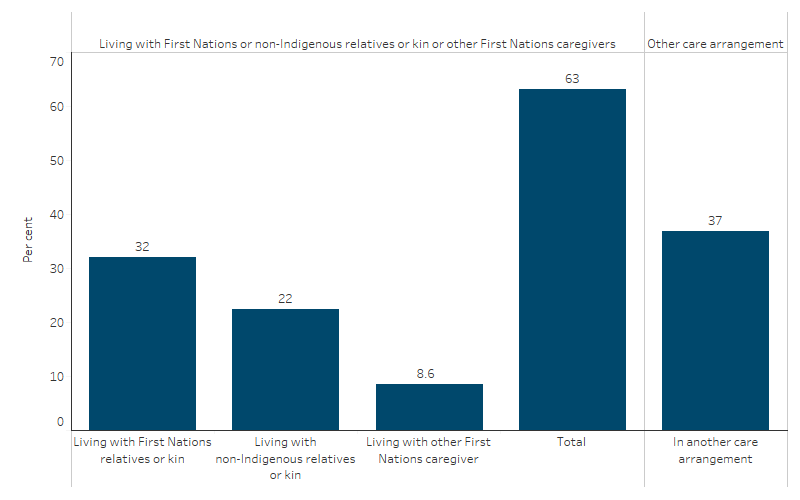
Note: 'In another care arrangement' includes children living with non-Indigenous carers who are not relatives or kin, in residential care, in family group homes and children living independently.
Source: Table D2.12.13. AIHW Child Protection Collection 2023–24.
Cultural support plans include details such as the child’s cultural background and actions taken to maintain their connection to culture (AIHW 2025a). Legislation in each state and territory determines whether children are required to have cultural support plans.
In accordance with the ATSICPP connection indicator 2.2:
- At 30 June 2024, 17,451 First Nations children in out-of-home care were required to have a current, documented and approved cultural support plan – of these, 82% (14,362) had a plan in place, a 13.1 percentage point increase since 2020 (AIHW 2025a).
Reunification is a planned process of safely enabling a child to return to their birth parents, family or former guardian. For First Nations children, this can mean potentially re-establishing the closest possible connection to their family, community and culture, especially for those children who were placed with non-Indigenous carers who are not relatives or kin. Successful reunification can be measured by looking at whether the child had returned to out-of-home care within a specific period after a reunification had taken place.
In accordance with the ATSICPP connection indicators 2.3 and 2.4:
- In 2023–24, when excluding children on long-term guardianship orders from the total number of First Nations children in out-of-home care, 13% (1,412) of the 10,509 First Nations children aged 0–17 in out-of-home care were reunified during the year (AIHW 2025a: Table 10.15).
- Of 1,601 First Nations children aged 0–16 who were reunified with family during 2022–23, 85% (1,353) did not return to out-of-home care within 12 months (AIHW 2025a: Table 10.19).
In 2023–24, 95% (1,443) of First Nations children aged 0–17 in out-of-home care (including children on long-term guardianship orders) who were reunified, were reunited with their birth parents (ATSICPP indicator 2.8), none with relatives or kin (ATSICPP indicator 2.9), with the remaining 5% (81) unknown or other (AIHW 2025a: Table 10.18).
Youth justice supervision and prior contact with the child protection system
During 2022–23, 4,575 First Nations young people aged 10–17 were under some type of youth justice supervision. Of these, over three-quarters (76% or 3,489) came into contact with the child protection system during the 10-year period from 1 July 2013 to 30 June 2023. In contrast, 55% of non-Indigenous young people under youth justice supervision came into contact with the child protection system during the same 10-year period.
Of First Nations males (3,478) and females (1,095) aged 10–17 who were under youth justice supervision during 2022–23, a higher proportion of females (83% or 904) than males (74% or 2,583) came into contact with the child protection system during the 10-year period from 1 July 2013 to 30 June 2023 (AIHW 2024: Table S1).
Comparisons with non-Indigenous Australians
In 2023–24, 57,789 First Nations children and 112,828 non-Indigenous children received child protection services. First Nations children aged under 18 were about 7 times as likely as non-Indigenous children to receive child protection services (146 per 1,000 First Nations children and 21 per 1,000 non-Indigenous children) (Table D2.12.1).
Of 40,468 children with known Indigenous status who were the subjects of substantiations of notifications received during 2023–24, 32% (12,965) were First Nations children and 68% (27,503) were non-Indigenous children. Considered as a population rate, substantiated maltreatments were 6 times as high for First Nations children as for non-Indigenous children (33 compared with 5.1 per 1,000 children) (Table D2.12.3).
First Nations children who were the subjects of substantiations of notifications received during 2023–24 were on average younger than non-Indigenous children – 43% were under the age of 5 compared with 31% of non-Indigenous children (Table D2.12.2).
Rates of all maltreatment types were higher for First Nations children aged 0–17 compared with non-Indigenous children:
- The rate of emotional abuse (the most common type of maltreatment) was 16.8 per 1,000 First Nations children compared with 3.1 per 1,000 non-Indigenous children.
- The rate of neglect was 9.6 per 1,000 First Nations children compared with 0.9 per 1,000 non-Indigenous children.
- The rate of physical abuse was 3.7 per 1,000 First Nations children compared with 0.7 per 1,000 non-Indigenous children.
- The rate of sexual abuse (the least common type of maltreatment for both groups) was 2.5 per 1,000 First Nations children compared with 0.5 per 1,000 non-Indigenous children (Productivity Commission 2025: Table SE12m.1).
At 30 June 2024, of 59,772 children on care and protection orders for whom Indigenous status was known, 42% (25,021) were First Nations children and 58% (34,751) were non-Indigenous children. Population rates of care and protection orders were 10 times as high for First Nations children as for non-Indigenous children (63.0 compared with 6.4 per 1,000 children) (Table D2.12.7).
At 30 June 2024, of 44,792 children in out-of-home care for whom Indigenous status was known, 45% (19,987) were First Nations children and 55% (24,805) were non-Indigenous children. The rate of out-of-home care among First Nations children was nearly 11 times as high as for non-Indigenous children (50 compared with 4.6 per 1,000 children) (Table D2.12.12).
In 2023–24, 13% of First Nations children aged 0–17 in out-of-home care (excluding children on long-term guardianship orders) were reunified during the year, compared with 18% of non-Indigenous children. Of First Nations children aged 0–16 who were reunified with family during 2022–23, 85% did not return to out-of-home care within 12 months, compared with 88% for non-Indigenous children (AIHW 2025a).
Changes over time
The data used to measure trends in substantiated maltreatments, care and protection orders and out-of-home care are drawn from the Child Protection National Minimum Data Set (CP NMDS). Data are presented for a 5-year period, as changes in state and territory legislation, policy/practice and information management systems reduce the ability to accurately compare data over longer periods. Changes over time in substantiated maltreatments, out-of-home care, and care and protection orders are shown in Figure 2.12.4.
Child protection processes may have been affected due to measures put in place as part of government responses to COVID-19 during 2020 and 2021 (including travel bans/restrictions, lockdowns limiting non-urgent face-to-face work, remote learning for students and quarantine requirements). However, the long-term impact of COVID-19 on child protection processes and on the annual data are still unknown (AIHW 2023).
Substantiated maltreatments
Nationally, over the period from 2019–20 to 2023–24, the rate of substantiated maltreatments among First Nations children decreased from 38 per 1,000 children in 2019–20 to 33 per 1,000 children in 2023–24. The rate of substantiated maltreatments for non-Indigenous children also decreased (from 6.3 to 5.1 per 1,000 children). Over this period, the absolute gap (rate difference) remained similar, while the relative difference (rate ratio) between First Nations and non-Indigenous children increased from 5.9 in 2019–20 to 6.4 in 2023–24 (Table D2.12.1).
Across jurisdictions, there was no statistically significant change in substantiated maltreatments for First Nations children in any jurisdiction except New South Wales, where rates of First Nations children who were the subjects of substantiated maltreatments decreased from 42 to 30 per 1,000 children over the period 2019–20 to 2023–24 (Table D2.12.5).
Care and protection orders
Nationally, over the period from 30 June 2020 to 30 June 2024, there was no statistically significant change in the rate of First Nations children on care and protection orders (ranging between 61 and 63 per 1,000 children). There was, however, a statistically significant decrease in the rate for non-Indigenous children in the same period, from 7.1 per 1,000 children to 6.4 per 1,000 children. As a result, the absolute gap (rate difference) between the two population groups increased from 54 to 57 per 1,000 children, and the relative difference (rate ratio) rose from 8.6 in 2020 to 9.8 in 2024 (Table D2.12.11).
Across jurisdictions over the period from 30 June 2020 to 30 June 2024, there was a statistically significant increase in the rates of care and protection orders for First Nations children in Queensland (17% increase, from 47 at 30 June 2020 to 55 per 1,000 children at 30 June 2024), South Australia (14% increase, from 78 to 90 per 1,000 children) and Tasmania (15% increase, from 37 to 42 per 1,000 children). The Northern Territory was the only jurisdiction reporting a statistically significant decrease in this rate (14% decrease, from 36 to 31 per 1,000 children). The remaining 4 jurisdictions showed no statistically significant change over this same period (Table D2.12.11).
Out-of-home care
Nationally, between 30 June 2020 and 30 June 2024, the rate of out-of-home care among First Nations children showed no significant change (49 in 2020 to 50 per 1,000 children in 2024), while there was a statistically significant decrease in the rate for non-Indigenous children (from 5.2 to 4.6 per 1,000 children). As a result, the absolute gap (rate difference) between the two population groups increased from 44 to 46 per 1,000 children, and the relative difference (rate ratio) rose from 9.6 in 2020 to 11.0 in 2024 (Table D2.12.1).
Across jurisdictions from 30 June 2020 to 30 June 2024, there was a statistically significant increase in the rates of out-of-home care among First Nations children in Victoria (81 to 91 per 1,000 children), Queensland (36 to 43 per 1,000 children) and South Australia (75 to 83 per 1,000 children). Over the same period there was a statistically significant decrease in the rates of out-of-home care among First Nations children in New South Wales (50 to 45 per 1,000 children) and the Northern Territory (35 to 30 per 1,000 children) (Table D2.12.17).
Between 2019–20 and 2023–24, the rate of children who were admitted to out-of-home care was generally higher than the rate of those discharged in all years except 2021–22 when the admission and discharge rates were similar (10.4 and 10.7 per 1,000 children, respectively). There was no clear trend in the rate of First Nations children admitted to out-of-home care between 2019–20 and 2023–24, with rates ranging between 10.4 per 1,000 (in 2021–22) and 12.0 per 1,000 children (in 2019–20). The discharge rate also remained broadly similar, ranging from 10.2 to 10.9 per 1,000 children between 2019–20 and 2023–24 (Table D2.12.19, Table D2.12.20).
Figure 2.12.4: Children in different components of the child protection system, by Indigenous status, 2020 to 2024
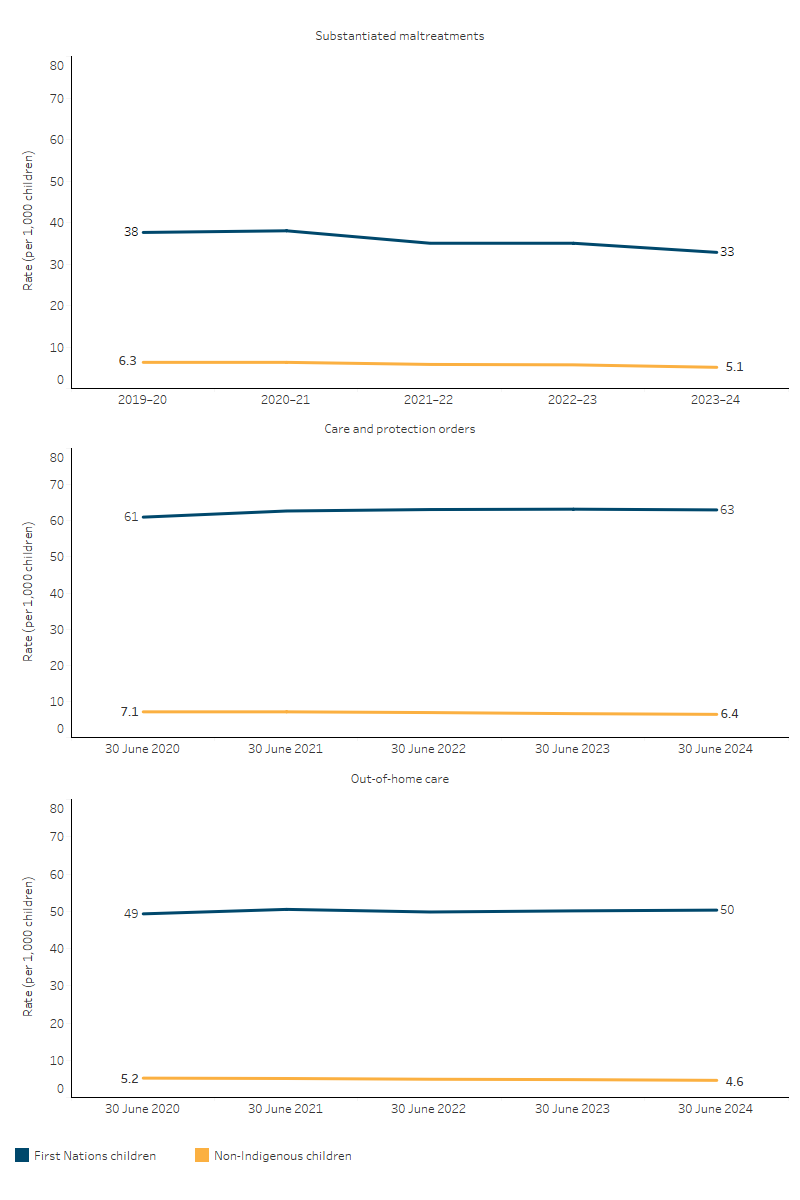
Source: Table D2.12.1. AIHW Child protection Collection 2019–20 to 2023–24.
Research and evaluation findings
Over-representation of First Nations children
Research and evaluation findings highlight the resilience and strength of First Nations communities in addressing the over-representation of their children in child protection and out-of-home care. The over-representation is compounded by the intergenerational trauma from past policies of forced removal and intertwined with factors such as poverty, housing issues, lack of culturally safe services, family violence, substance use, and mental health challenges (AIHW 2025b).
The National Anti-Racism Framework Scoping Report 2022 underscores the exploitation of First Nations children since colonisation and the ‘protectionist legislation’ that led to the Stolen Generations. Despite changes in child protection methods, systemic biases and racial disparities continue to affect First Nations families under current child protection laws administered by the states and territories.
The AIHW reported on the outcomes and experiences of the Stolen Generations and potential intergenerational effects on children. Compared with a reference group of First Nations adults who had neither been removed from their families nor reported having relatives who had been removed, Stolen Generations descendants were: twice as likely to have experienced discrimination in the preceding 12 months, 1.9 times as likely to have experienced violence, 1.6 times as likely to be in poor health, 1.5 times as likely to have been arrested by police in the past 5 years, 1.4 times as likely to have low levels of trust in the general community, and 1.3 times as likely to report poor mental health (AIHW 2018). First Nations children living with Stolen Generations members were 4.5 times as likely to have missed school without permission in the last 12 months, 1.6 times as likely to have poor self-assessed health, and 1.6 times as likely to live in a household with cash-flow problems in the last 12 months (AIHW 2019a).
Fears of child removal can discourage First Nations families from seeking health or support services. For example, children with ear disease may go undiagnosed due to parents fearing removal if they ‘went to the doctors too often with a sick child’ (Campbell et al. 2022). Mothers with domestic violence-related injuries may hide the truth about their injuries or avoid seeking help at all (Fitts et al. 2023). Furthermore, Western cultural perspectives on child rearing and parental involvement differ in important ways from First Nations holistic relational networks of caregivers and cultural values of connectedness, wellbeing and child autonomy which can lead to misinterpretations of parental behaviours as neglectful (Wright et al. 2024). These examples highlight the need for culturally appropriate and safe services for First Nations families.
The Family Matters Report 2024 presents data showing an increasing over-representation of First Nations children in out-of-home care, while at the same time there is limited First Nations involvement in service design and decision-making. The report also notes that Aboriginal Community-Controlled Organisations (ACCOs), which have demonstrated effectiveness in providing cultural support and family reunification (Creamer et al. 2024), receive a disproportionately low share of government funding. Nationally (excluding the Northern Territory as data was not provided) ACCOs received 6% of child protection expenditure in 2022–23, despite First Nations children comprising 41% of the out-of-home care population (SNAICC et al. 2024).
The ‘Breaking the cycle’ study highlights the strength of First Nations communities in addressing the over-representation of their newborns in out-of-home care. Families participating in the First Nations-led Birthing in Our Community (BiOC) program at a Brisbane hospital had significantly lower odds of their babies being removed at birth than First Nations families receiving standard care at the same hospital (O'Dea et al. 2024). The BiOC model has also been shown to be more cost-effective than standard care (Gao et al. 2023). A case study on the Tangentyere Safe House, operated by Tangentyere Council Aboriginal Corporation in Alice Springs, illustrates an ACCO’s approach to out-of-home care for First Nations children. The Safe House provides temporary care for children aged 0–12 whose families are experiencing short-term challenges, with the aim of supporting family reunification and maintaining children’s connection to culture, community, and Country. The model is distinct from residential care, emphasising a home-like environment, cultural safety, and active involvement of families in the care process. Key features include a stable and culturally diverse carer team, integration of cultural practices, and child-centred decision-making. According to reflective practice and focus group discussions with staff, the model has contributed to positive care experiences, including stronger relationships with families and improved staff retention (Brown et al. 2024).
Child maltreatment and protection notifications
The Australian Child Maltreatment Study (ACMS) is the first nationally representative study capturing prevalence data for all 5 types of child abuse and neglect. The first wave of data for the ACMS was released on 3 April 2023. Whilst the results do not provide specific estimates for First Nations people, they highlight that child maltreatment is common across Australia and has profound effects on mental health. Nearly 48% of those who experienced maltreatment have a mental health disorder, more than double the rate of those who have not (Haslam et al. 2023).
Research using ACMS data found that experiencing multiple types of maltreatment strongly influences the development of mental health disorders and health risk behaviours. This underscores the need for therapeutic services and public health policies tailored to addressing multi-type maltreatment (Higgins et al. 2023).
Multiple and intersecting factors including systemic racism, socioeconomic disadvantage and intergenerational trauma are associated with increased risk of family violence, substance dependence, abuse and childhood trauma among First Nations families. These factors contribute to higher rates of contact with child protection authorities and the criminal justice system. The Wiyi Yani U Thangani (Women's Voices) Report highlights the importance of prevention and early intervention to support families experiencing vulnerability. They expressed the feeling that the government approach to child welfare was focussed on judging and policing First Nations families, as opposed to supporting and working with them. The report calls for reinvestment of funding from the child protection system into culturally safe support services, recognising that such approaches would lead to better outcomes for families (AHRC 2020).
Family violence, often categorised as ‘emotional abuse’, and parental alcohol and/or drug abuse, are leading causes of First Nations children’s entry into out-of-home care. An inquiry in Victoria found that 88% of First Nations children in out-of-home care were impacted by family violence, and 87% were affected by a parent with alcohol or substance abuse issues (Commission for Children and Young People 2016), see measure 2.10 Community safety.
A multiagency study in the Northern Territory found that maternal alcohol consumption during pregnancy was associated with higher odds of reported child maltreatment (odds ratio: 2.31). Low birth weight and smoking during pregnancy were also associated with increased odds of reported maltreatment (odds ratio: 2.05 and 1.56 respectively). Children with a history of maltreatment were more likely to be developmentally vulnerable at school entry, emphasising the need for targeted interventions and place-based strategies (He et al. 2019).
The Yoorrook Justice Commission was established in Victoria to address systemic injustices faced by First Nations people, particularly in areas such as child protection and the criminal justice system. Yoorrook’s work is grounded in truth-telling and prioritises the voices, experiences, and rights of First Nations communities, including their right to self-determination. In its 2023 report, Yoorrook highlighted that First Nations children are significantly over-represented in child protection notifications, with many of these reports ultimately unsubstantiated. The Commission found that systemic racism – particularly within health and universal services – drives over-reporting, especially through pre-birth notifications. In 2022 alone, 491 pre-birth reports were made about First Nations children, accounting for around one in five of all such reports. Evidence presented to Yoorrook revealed that racist stereotypes and assumptions about First Nations mothers continue to influence reporting practices, causing unnecessary trauma and contribute to the removal of babies shortly after birth. The Commission also noted that ACCOs face funding disparities and workforce instability due to short-term contracts with government funding sources, undermining culturally safe support systems for families (Yoorrook Justice Commission 2023). ‘Unborn reports’ are notifications to child protection authorities about children who are not yet born. There is a lack of consistent data on unborn reports across states and territories, but inquiries in Victoria and South Australia indicate that unborn reports are more common for First Nations families than for non-Indigenous families, and are increasing (SNAICC et al. 2024).
A study of 15,815 First Nations children in Western Australia found that 41% had contact with child protection services, with 9% placed in out-of-home care. Infants with notifications were more likely to have substantiated abuse and neglect and be placed in out-of-home care. Kinship care was predominant, although only 22% had their first placement with kinship carers (Lima et al. 2024).
Assessments of ‘neglect’ in First Nations families are sometimes not culturally informed, with First Nations family structures and child-rearing practices at times being mistakenly perceived as unstable or neglectful due to differences with Western child-rearing practices (Queensland Department of Families Seniors Disability Services and Child Safety 2025). Research indicates that First Nations concepts of neglect relate to cultural obligations, kinship responsibilities and connection to Country, whereas Western systems define neglect primarily in terms of material deprivation and individual parental failure. This difference in definitions, combined with systemic factors such as poverty and racism, contributes to the overrepresentation of First Nations children in out-of-home care (Tilmouth et al. 2025).
Experiences of First Nations children in care
A case study centring on the story of a young First Nations woman highlights the importance of kinship care for First Nations children. When faced with adversity, such as family violence, First Nations culture acts as a protective factor. Cultural strengths within kinship environments foster a sense of belonging, self-esteem, and self-confidence in children (Sorby et al. 2024).
The article Actioning children’s rights in out-of-home care in NSW: A focus on the right of family connection emphasises the importance of prioritising the rights of children in out-of-home care, especially the right to family connection in New South Wales. The article discusses the positive impact of recent reviews and reforms in NSW, which have led to more empathetic and historically informed casework practices. These practices focus on maintaining family connections and addressing the impacts of family separation, thereby promoting healing and better outcomes for children and families involved in the child protection system. The findings emphasise the strength and resilience of First Nations communities in advocating for and implementing rights-based, culturally appropriate care practices (Forrester and Byers 2024).
The out-of-home care system itself also poses risks to child safety. In 2023–24, there were 667 First Nations children that were the subject of a substantiation of abuse while in out-of-home care, 45% of total substantiations of abuse in care (AIHW 2025a: Table S9.1). Children may also experience abuse while under government care in the form of neglect and poor treatment. This poor treatment includes the provision of unstable accommodation, the absence of stable and appropriate caregivers, and disconnection from their family and culture (SNAICC et al. 2024).
Children and young people who have been abused or neglected are at greater risk of engaging in criminal activity and of entering the youth justice system. First Nations young people under youth justice supervision are more likely to have had an interaction with the child protection system. During 2022–23, about 3 in 4 (76%) of First Nations youth under supervision had received child protection services in the previous 10 years, compared with 55% of non-Indigenous youth (AIHW 2024). Children in care are more likely to experience criminalisation, which occurs when children are stigmatised and their behaviour is labelled and treated as criminal in contexts in which other children may receive a different, more proportional response (Queensland Family & Child Commission 2018). Criminalisation of children in care is also influenced by complex interactions between trauma, mental health conditions, the care environment, and difficulties in locating suitable accommodation (McGrath et al. 2020).
An investigation by Kennedy (2020) of health care for First Nations children in out-of-home care highlighted their over-representation and the urgent need for a health-care model aligned with the National Clinical Assessment Framework for Children and Young People in Out-of-home Care’s minimum standards. The investigation emphasised the importance of self-determination and First Nations-led approaches in policy and program development. It recommended a national strategy to implement the National Clinical Assessment Framework, including developing health indicators, integrating medical and mental health services, and enhancing electronic health records. Capacity building within First Nations organisations and effective collaboration between health and child protection sectors are crucial. The investigation highlighted the need for efforts in prevention and early intervention to improve health outcomes for First Nations children in out-of-home care, aiming for a comprehensive, integrated, culturally sensitive, and effective health-care model (Kennedy 2020).
The article Safety, Innovation, and Hope in Out-of-Home Care acknowledges the historical impact of transgenerational trauma and the over-representation of First Nations children in care. The article emphasises innovative, trauma-informed, and culturally appropriate practices that focus on child safety, family-centred care, and adherence to the ATSICPP. It also underscores the importance of therapeutic responses to trauma and the need for continuous improvement in care practices to ensure the wellbeing of children (Miller and and Singh 2024).
Evaluations of programs strengthening child and family support systems
The Australian Nurse-Family Partnership Program is a culturally safe program delivered by ACCOs, which aims to improve outcomes for First Nations mothers and children. A study in Central Australia found that children of young (aged under 20) and first-time mothers in the program had lower rates of involvement with child protection (Segal et al. 2018).
The Queensland Government’s Keeping Families Together (KFT) Supporting Housing pilot project provided secure and affordable housing for 20 families along with intensive and holistic family supports. Stable housing positively impacted overall family wellbeing. Families participating in KFT also experienced reduced child protection intervention, with both families and child support officers framing KFT as a protective factor (Kuskoff et al. 2021), (see measure 2.01 Housing).
Maintaining connections to family, community and culture is particularly important for First Nations families. However, evidence shows that there are barriers to maintaining this connection, including a shortage of First Nations carers and resources to accommodate First Nations children needing to be placed in out-of-home care (Arney et al. 2015). Despite this shortage, First Nations women reported being excluded from caring for First Nations children through carer assessment processes which created standards of appropriateness that were almost impossible to meet (AHRC 2020).
An evaluation of the Intensive Family Support Service (IFSS) in the Northern Territory and Anangu Pitjantjatjara Yankunytjatjara, APY Lands, commissioned by the Department of Social Services (DSS) and conducted by Social Compass in 2020, found that the program played a critical role in supporting vulnerable families – including First Nations families. IFSS delivered intensive, home-based parenting education and support over a 12-month period, aiming to improve child safety, health, and wellbeing. The evaluation identified that culturally appropriate, trauma-informed, and strengths-based approaches were central to the program’s success. Specifically, the use of locally designed tools and bicultural teams were crucial for building trust, engaging families meaningfully, and tailoring support to local cultural contexts. Despite operational challenges such as high staff turnover, limited access to complementary services, and difficulties in data collection, stakeholders reported a range of positive outcomes. These included increased parenting confidence, stronger family relationships, and improved safety and wellbeing for children. In response to these findings, DSS collaborated with the Australian Centre for Child Protection to redesign the program, embedding strong cultural governance, community-led service design, and greater flexibility. Building on these foundations, DSS launched the Children and Family Intensive Support Program (CaFIS) in November 2021, with a focus on enabling ACCOs to deliver trauma-informed, culturally safe, and locally responsive services that meet the needs of their communities (DSS 2020; Social Compass 2020).
Four Victorian ACCOs came together to trial 3 child protection diversion programs: the Aboriginal-Led Case Conferencing Trial (ALCC), the Aboriginal-Led Aboriginal Family Decision-Making During Open Investigation Program Trial (AFLDM) and the Garinga Bupup (‘growing babies’) Trial (in Bendigo). An evaluation of these trials found the ALCC trial had a 78% diversion success rate and Garinga Bupup had a 63% diversion success rate, equating to a $5 and $2 return on every $1 invested respectively. Factors identified as key to the success of these programs include safe, empowering and trusting relationships, being enabled by an Aboriginal service provider, culturally grounded practices, and strong links with child protection authorities (Wise and Brewster 2022).
Implications
All Australian governments agree that children in Australia have the right to grow up safe, connected, and supported in their family, community, and culture. They also affirm the right to an environment that enables children to reach their full potential. This is consistent with the Australian Government’s endorsement of the United Nations Declaration on the Rights of Indigenous Peoples (UNDRIP), which recognises the right of Indigenous people to live in freedom and peace and not be subject to forced child removal (UN General Assembly 2007). All Australian governments are also signatories to the National Agreement on Closing the Gap, which includes specific targets to reduce the over-representation of First Nations children in out-of-home care and to reduce all forms of family violence and abuse against First Nations women and children.
First Nations children in Australia are significantly over-represented at every stage of the child protection system. As reporting for Closing the Gap Target 12 on out-of-home care has shown, the rates for First Nations children in Victoria and South Australia are particularly high. Systemic racism and biases in the Victorian child protection system and health system have been investigated and highlighted by SNAICC – National Voice for our Children (SNAICC 2025); the Victorian Commissioner for Aboriginal Children and Young People (as cited in SNAICC (2021)); and the Yoorrook Commission (Yoorrook Justice Commission 2023, 2025). The rate of child removal in Victoria has prompted these organisations to draw concerning parallels to the period of the Stolen Generations.
Despite ongoing efforts, First Nations children continue to experience higher rates of substantiated maltreatment. Addressing this requires a deep understanding of the underlying causes of child maltreatment, which are often rooted in historical and systemic disadvantage. The long-term effects of maltreatment vary depending on factors such as its nature, duration, and the level of family and community support. Therefore, prevention needs to be a key element of policy responses to support families and communities to care for children safely (McIntosh and Phillips 2002; SCRGSP 2016).
Structural reforms and policy initiatives should prioritise prevention and early intervention to reduce the number of children entering child protection systems. Primary prevention includes universal access to culturally responsive services, and activities and programs with a whole-of-community focus, while early intervention includes support services targeting families experiencing difficulties. Statutory intervention (for children and families where maltreatment has been identified) aims to ensure safety and appropriate care, and prevent harm from re-occurring (AHRC 2019; Family Matters et al. 2019). Reforms should address the gap in culturally safe care for parents experiencing trauma and violence (Chamberlain et al. 2025). The Australian Human Rights Commission (AHRC)’s 2024 report, Help Way Earlier!, emphasised the need for early intervention strategies that are culturally attuned and community-driven to enhance the safety and wellbeing of First Nations children.
One example of a prevention and early intervention project is the Replanting the Birthing Trees project by the University of Melbourne School of Population and Global Health which addresses the impact of trauma on First Nations parents (Chamberlain et al. 2025). Grounded in the traditional concept of a Birthing Tree, the project aims to create safe and sacred spaces for First Nations women, offering culturally safe assessments, resources, and support to enhance wellbeing during the pivotal first 2,000 days of life. As Chamberlain and colleagues emphasise, the first 2,000 days of a child’s life is a critical opportunity to address cycles of trauma and invest in healing, through comprehensive modes of care grounded in self-determination and culture. Other research has also highlighted the critical stage of infancy, when early intervention and family support strategies may prevent initial child protection involvement and promote kinship placement and reunification (Lima et al. 2024).
SNAICC – National Voice for our Children, is the national community-controlled peak body for First Nations children, families and the sectors that support them. SNAICC advocates for strengthening the ACCO sector that delivers holistic, culturally safe services to support First Nations children and families. In 2022, SNAICC was engaged by the Department of Social Services (DSS) to conduct part one of the Stronger Aboriginal Community-Controlled Organisations (ACCOs), Stronger Families project. This stage identified strengths, needs, barriers, and opportunities for ACCOs in accessing DSS funding and delivering families and children-related programs.
The Stronger ACCOs, Stronger Families Part 2 project aims to continue strengthening genuine partnerships between non-Indigenous organisations and ACCOs. The project will run in 2 tranches: the first focuses on partnering with Leading Regions sites to strengthen partnerships and collect learnings, while the second will implement these learnings with providers (SNAICC 2022).
The prevention of family violence is a critical part of preventing children being in need of the child protection system. In recent years, the Australian Government has been working with partners on a range of strategies to raise awareness and convene action on preventing family violence.
The National Plan to End Violence against Women and Children 2022–2032 (National Plan), developed with First Nations leadership, guides actions to end violence over the next decade (Australian Government 2023). The National Plan recognises children as victims in their own right and outlines actions to prevent and address violence against children across 4 domains: prevention, response, recovery, and healing. The Australian Government is also undertaking development of the Our Ways – Strong Ways – Our Voices: National Aboriginal and Torres Strait Islander Family Safety Plan in partnership with First Nations communities, the ACCO sector, and state and territory governments. The Family Safety Plan will guide a whole of society approach to addressing the unacceptable rates of violence against First Nations women and children.
The Aboriginal and Torres Strait Islander Action Plan 2023-2025 (Family Safety Action Plan) sits under the National Plan and is fundamental to addressing the family violence target (Target 13) of the National Agreement on Closing the Gap. The Family Safety Action Plan was developed in genuine partnership with the Aboriginal and Torres Strait Islander Advisory Council on family, domestic and sexual violence (FDSV). The Family Safety Action Plan recognises the disproportionately high rates of FDSV that First Nations people experience and acknowledges the intersections of family violence, child protection and youth justice systems and the systemic and structural transformation of mainstream government organisations required to improve accountability and respond to the needs of First Nations people.
To support these actions, the National Plan and the Family Safety Action Plan align with 2 key initiatives aimed at improving outcomes for children:
- Safe and Supported: the National Framework for Protecting Australia’s Children 2021-2031: This successor to the 2009-2020 framework sets out a 10-year strategy to improve the lives of disadvantaged and vulnerable children, young people, and families. It focuses on delivering real outcomes through better coordination with other programs and supporting families to keep their children safe. The framework is implemented through 2 sets of Action Plans, Safe and Supported: First Action Plan 2023–2026 and Safe and Supported: Aboriginal and Torres Strait Islander First Action Plan 2023–2026, launched in January 2023.
- National Strategy to Prevent and Respond to Child Sexual Abuse 2021–2030: This strategy aims to prevent and respond to child sexual abuse through comprehensive measures.
The Australian Government, state and territory governments, First Nations representatives and the non-government sector are working together through ‘Safe and Supported’ towards the shared goal of making significant and sustained progress in reducing the rate of child abuse and neglect and its intergenerational impacts. This includes emotional abuse, the most common primary type of abuse or neglect substantiated through child protection investigations. Children affected by exposure to family violence are included in this category.
Additionally, the National Aboriginal and Torres Strait Islander Early Childhood Strategy (2021) highlights the importance of a holistic approach to child development, focusing on safety, family support, education, health, and cultural preservation. The establishment of the National Commission for Aboriginal and Torres Strait Islander Children and Young People in January 2025 further reinforces the commitment to safeguarding the rights and wellbeing of First Nations children, addressing critical issues such as their over-representation in out-of-home care. Collectively, these policies represent a concerted effort to integrate culturally informed practices into national frameworks, ensuring that First Nations voices and leadership are central to the development and implementation of these strategies.
The Australian Government plays a coordinating and supportive role in addressing the complex and interconnected issues involving family and child safety. This includes funding initiatives through non-government organisations and the ACCO sector, with a strong focus on prevention. However, the primary responsibility for administration of the child protection system and the protection of children experiencing or at risk of experiencing abuse and neglect, sits with state and territory governments. The national strategies and plans recognise the need for systemic transformation and also highlight the importance of collaboration across service sectors, including family violence, early childhood, child protection, and justice. Most jurisdictions have introduced strategies aimed at supporting families more holistically through better coordination of family support services and improving service access.
Despite these efforts, child protection systems across the country often face challenges such as limited resources and workforce capacity, which can affect their ability to fully meet the needs of First Nations children. The ATSICPP is one way that these systems endeavour to meet the needs of First Nations children who are in need of out-of-home care. Continued support is essential to ensure its effective implementation. Out-of-home care should remain a last resort, with strong emphasis on reuniting children with their families when possible. Many children can be safely reunited with their families when their families receive appropriate supports and interventions.
In late 2021, the Australian Government established the National Centre for Action on Child Sexual Abuse (National Centre), led by the Blue Knot Foundation, the Australian Childhood Foundation, and The Healing Foundation. The National Centre aims to raise awareness, reduce stigma for victims and survivors, build workforce capability, and develop better intervention models through research and evaluation. Its Five-Year Strategic Plan, Here for Change, launched in June 2023, marks a commitment to transforming the understanding and response to child sexual abuse in Australia.
The Australian Child Maltreatment Study (ACMS), which captures prevalence data for all 5 types of child abuse and neglect, also examines long-term mental and physical health impacts. Under the National Strategy to Prevent and Respond to Child Sexual Abuse 2021–2030, the Australian Government has committed $22.4 million for further work by the ACMS, including scoping a second wave of the study involving co-design with First Nations stakeholders and other groups not captured in the first wave of the study (Rishworth and Dreyfus 2023).
Gaps in identifying First Nations children in the child protection system can deprive them of culturally safe support, case planning and placement. These gaps may also affect the accuracy of data describing their interactions with services (SNAICC et al. 2024). Addressing these data limitations is essential to ensuring that responses are culturally responsive and aligned with the ATSICPP.
The Closing the Gap Data Development Plan 2022-2031 outlines a number of priority actions to improve data quality and availability under Outcome12 (Child Protection) and Outcome 13 (Safe Families and Households). These include the development of nationally consistent indicators for culturally competent child protection responses, improved identification practices, and enhanced data linkage to support long-term outcomes monitoring (Joint Council on Closing the Gap 2022).
References
- AHRC (Australian Human Rights Commission) (2015) The Social Justice and Native Title Report 2015, AHRC.
- AHRC (2019) Children's rights report 2019— in their own right: children's rights in Australia .
- AHRC (2020) Wiyi Yani U Thangani (women's voices): securing our rights, securing our future report, report prepared by A Campbell, A Stevens, A Dozer, D Dick, E Holden, J Pedersen, K Hunter, K Gray, L George, N Devereaux and S Spry, AHRC, accessed 26 March 2026.
- AIC (Australian Institute of Criminology) (2005) Children on care and protection orders in Australia, AIC.
- AIHW (Australian Institute of Health and Welfare) (2018) Aboriginal and Torres Strait Islander Stolen Generations and descendants: numbers, demographic characteristics and selected outcomes, AIHW, Australian Government, accessed 26 March 2026.
- AIHW (2019a) Children living in households with members of the Stolen Generations, AIHW, Australian Government, accessed 2 April 2026.
- AIHW (2019b) Young people in child protection and under youth justice supervision: 1 July 2014 to 30 June 2018, AIHW, Australian Government, accessed 3 April 2026.
- AIHW (2023) Child protection Australia 2021–22, AIHW, Australian Government, accessed 3 April 2026.
- AIHW (2024) Young people under youth justice supervision and their interaction with the child protection system 2022–23, AIHW, Australian Government, accessed 8 April 2026, doi:10.25816/gs60-xv16.
- AIHW (2025a) Child protection Australia 2023–24, AIHW, Australian Government, accessed 8 April 2026.
- AIHW (2025b) Youth justice in Australia 2023–24, AIHW, Australian Government, accessed 8 April 2026.
- Arney F, Iannos M, Chong A, McDougall S and Parkinson S (2015) Enhancing the implementation of the Aboriginal and Torres Strait Islander Child Placement Principle: Policy and practice considerations, Australian Institute of Family Studies, Australian Government.
- Atkinson J (2013) Trauma-informed services and trauma-specific care for Indigenous Australian children, Closing the Gap Clearinghouse, AIHW, AIFS, Australian Government.
- Australian Government (2023) Australian Government Response to the House of Representatives Standing Committee on Social Policy and Legal Affairs Report: Inquiry into family, domestic and sexual violence, Australian Government.
- Brown C, Maree C, Steve A, Samantha J, Samantha S, Kay W, Siddharth S, Sharon A and and Tiltsen S (2024) 'Sharing the Care: One Aboriginal Community-Controlled Organisation’s Approach to Out-of-Home Care of Aboriginal and Torres Strait Islander Children', Australian Social Work, 77(4):513–526, doi:10.1080/0312407X.2024.2386438.
- Burton J, Young J, Jayakody N, Ruggiero E and Thwaites R (2018) The Aboriginal and Torres Strait Islander Child Placement Principle: A guide to support implementation, The Secretariat of National Aboriginal and Islander Child Care (SNAICC).
- CACYP (Commission for Aboriginal Children and Young People) (2024) The Inquiry into the Application of the Aboriginal and Torres Strait Islander Child Placement Principle in the Removal and Placement of Aboriginal Children in South Australia, Commissioner for Aboriginal Children and Young People, accessed 2024.
- Campbell L, Reath J, Hu W, Gunasekera H, Askew D, Watego C, Kong K, Walsh R, Doyle K, Leach A, Tyson C and Abbott P (2022) 'The socioemotional challenges and consequences for caregivers of Aboriginal and Torres Strait Islander children with otitis media: A qualitative study', Health Expectations, 25(4):1374–1383, doi:10.1111/hex.13476.
- Chamberlain C, Gray P, Bennet D, Elliott A, Jackomos M, Krakouer J, Marriott R, O'Dea B, Andrews J, Andrews S, Atkinson C, Atkinson J, Bhathal A, Bundle G, Davies S, Herrman H, Hunter SA, Jones‐Terare G, Leane C, Mares S, McConachy J, Mensah F, Mills C, Mohammed J, Mudiyanselage LH, O'Donnell M, Orr E, Priest N, Roe Y, Smith K, Waldby C, Milroy H and Langton M (2022) 'Supporting Aboriginal and Torres Strait Islander Families to Stay Together from the Start (SAFeST Start): Urgent call to action to address crisis in infant removals', doi:10.26181/19084703.v2.
- Chamberlain C, Krakouer J, Gray P, Lyon M, Onwuka S, Chang EP, Nelson L, Duffield V, Mohamed J, Stocker S, Yunupingu Y, Maymuru S, Rossingh B, Stanley F, Cameron D, Metta M, Bright TM, Gayde R, Kelly B, Corrales T, Walker R, Lacroix T, Milroy H, Weatherstone A, Jones KA, Smith K and Langton M (2025) 'Replanting the Birthing Trees: A Call to Transform Intergenerational Trauma into Cycles of Healing and Nurturing', Genealogy, 9(2):52, doi:10.3390/genealogy9020052.
- Commission for Children and Young People (2016) ‘Always was, always will be Koori children’: Systemic inquiry into services provided to Aboriginal children and young people in out- of-home care in Victoria, Commission for Children and Young People.
- Creamer S, Suzi B, Maree T and and Brolan CE (2024) 'Indigenous services leading the way for Aboriginal and Torres Strait Islander children in out-of-home care', Social Work Education, 43(4):913–937, doi:10.1080/02615479.2022.2155129.
- Darwin L, Vervoort S, Vollert E and Blustein S (2023) Intergenerational trauma and mental health, AIHW website, accessed 17 December 2024.
- de Bortoli L, Coles J and Dolan M (2015) 'Aboriginal and Torres Strait Islander children in child protection: A sample from the Victorian Children’s Court', Journal of Social Work, 15(2):186–206, doi:10.1177/1468017314529511.
- DSS (Department of Social Services) (2020) Intensive Family Support Services. Department response to impact evaluation report by Wunan Foundation trading as Social Compass September 2020.
- Emerson L, Fox S and Smith C (2015) Good beginnings: getting it right in the early years – review of the evidence on the importance of a healthy start to life and on interventions to promote good beginnings, report to The Lowitja Institute, accessed 15 April 2026.
- Family Matters, SNAICC, University of Melbourne, Monash Univeristy and Griffith University (2019) The Family Matters Report 2019: Measuring trends to turn the tide on the over-representation of Aboriginal and Torres Strait Islander children in out-of-home care in Australia.
- Fitts M, Cullen J and Barney J (2023) 'Barriers Preventing Indigenous Women with Violence-related Head Injuries from Accessing Services in Australia', Australian Social Work, 76(3):406–419, doi:10.1080/0312407X.2023.2210115.
- Forrester SA and Byers P (2024) 'Actioning children's rights in out-of-home care in NSW: A focus on the right of family connection', Children Australia, 46(2):3031, doi:doi.org/10.61605/cha_3031.
- Gao Y, Roe Y, Hickey S, Chadha A, Kruske S, Nelson C, Carson A, Watego KR, M Costello, J , Tracy S and Kildea S (2023) 'Birthing on country service compared to standard care for First Nations Australians: a cost-effectiveness analysis from a health system perspective', The Lancet Regional Health Western Pacific, 34, doi:10.1016/j.lanwpc.2023.100722.
- Guthridge SL, Ryan P, Condon JR, Moss JR and Lynch J (2014) 'Trends in hospital admissions for conditions associated with child maltreatment, Northern Territory, 1999-2010', The Medical Journal of Australia, 201:162–166, doi:10.5694/mja14.00015.
- Haslam D, Mathews B, Pacella R, Scott J, Finkelhor D, Higgins D, Meinck F, Erskine H, Thomas H, Lawrence D and Malacova E (2023) The prevalence and impact of child maltreatment in Australia: Findings from the Australian Child Maltreatment Study: Brief Report, Australian Child Maltreatment Study.
- He V, Guthridge S and Leckning B (2019) From Birth to Five: A multiagency data-linkage study to inform a public health response to child protection in the Northern Territory, Menzies School of Health Research.
- Healy K, Venables J and Walsh T (2023) 'Supporting birth parents’ relationships with children following removal: A scoping review', Children and Youth Services Review, 149:106961, doi:10.1016/j.childyouth.2023.106961.
- Higgins DJ, Mathews B, Pacella R, Scott JG, Finkelhor D, Meinck F, Erskine HE, Thomas HJ, Lawrence DM, Haslam DM, Malacova E and Dunne MP (2023) 'The prevalence and nature of multi‐type child maltreatment in Australia', The Medical Journal of Australia, 218(S6):S19–S25, doi:10.5694/mja2.51868.
- Joint Council on Closing the Gap (2022) Data Development Plan - 2022-2030, National Indigenous Australians Agency, accessed 13 June 2025.
- Kennedy N (2020) Improving the Health of Aboriginal Children in Out-of-Home Care: the 2018 Jack Brockhoff Foundation Churchill Fellowship to investigate integrated models of care for Aboriginal children in out-of-home care (New Zealand, Canada, USA), The Winston Churchill Memorial Trust, accessed 10 June 2025.
- Kiraly M and Humphreys C (2016) '‘It's about the whole family’: family contact for children in kinship care', Child & Family Social Work, 21(2):228–239, doi:10.1111/cfs.12140.
- Kuskoff E, Parsell C, Ablaza C, Perales F, Clarke A and Plage S (2021) Keeping Families Together: Supporting Housing for Families, Micah Projects, accessed 26 March 2025.
- Lima F, Melissa OD, J. GA, Kathleen F, Emily B, Jocelyn J, Robyn W, Francine E, Benjamin H, Richard C, Olivia O and and Eades S (2024) 'Aboriginal Children Placed in Out-of-Home Care: Pathways Through the Child Protection System', Australian Social Work, 77(4):471–485, doi:10.1080/0312407X.2024.2326505.
- Lohoar S, Butera N and Kennedy E (2014) Strengths of Australian Aboriginal cultural practices in family life and child rearing, Child Family Community Australia, AIFS, DSS, Australian Government.
- Martin KL and Walter M (2017) 'The Story of LSIC: It's All About Trust and Vision', in Indigenous Children Growing Up Strong, Palgrave Macmillan, London, doi:10.1057/978-1-137-53435-4_3.
- McDonald K, Bamblett M, Curtis L, Ponchard K, Riviello N, Stanton N and Salamone C (2025) 'Aboriginal Children in Aboriginal Care: Transforming the Landscape of Child Protection in Australia', Genealogy, 9(3):66, doi: 10.3390/genealogy9030066.
- McIntosh G and Phillips J (2002) 'Who's Looking after the Kids? An Overview of Child Abuse and Child Protection in Australia'.
- Miller R and and Singh M (2024) 'Safety, Innovation, and Hope in Out-of-Home Care', Australian Social Work, 77(4):463–466, doi:10.1080/0312407X.2024.2395601.
- O'Dea B, Roe Y, Gao Y, Kruske S, Nelson C, Hickey S, Carson A, Watego K, Currie J, Blackman R, Reynolds M, Wilson K, Costello J and Kildea S (2024) 'Breaking the cycle: Effect of a multi-agency maternity service redesign on reducing the over-representation of Aboriginal and Torres Strait Islander newborns in out-of-home care: A prospective, non-randomised, intervention study in urban Australia', Child abuse & neglect, 149:106664, doi:10.1016/j.chiabu.2024.106664.
- Productivity Commission (2025) Socio-economic outcome area12 - Aboriginal and Torres Strait Islander children are not overrepresented in the child protection system – data tables, Australian Government, Productivity Commission website, accessed May 2026.
- Queensland Department of Families Seniors Disability Services and Child Safety (2025) Cultural differences in child-rearing practices – Child Safety Practice Manual accessed 17 October 2025.
- Queensland Family & Child Commission (2018) Joint agency protocol to reduce preventable police call-outs to residential care services, accessed 21 March 2025.
- Rishworth A and Dreyfus M (3 April 2023) Australian Child Maltreatment Study [media release], Office for The Hon Amanda Rishworth MP and The Hon Mark Dreyfus KC MP, Ministers for the Department of Social Services, accessed 9 May 2025.
- SCRGSP (Steering Committee for the Review of Government Service Provision) (2016) Overcoming Indigenous disadvantage: key indicators 2016, Productivity Commission.
- Segal L, Nguyen H, Gent D, Hampton C and Boffa J (2018) 'Child protection outcomes of the Australian Nurse Family Partnership Program for Aboriginal infants and their mothers in Central Australia', PloS One, 13(12).
- SNAICC (Secretariat of National Aboriginal and Islander Child Care) (2019) The Aboriginal and Torres Strait Islander Child Placement Principle: a gudie to support implementation, accessed 11 September 2023.
- SNAICC (2021) The Family Matters Report 2021, Family Matters Leadership Group and University of Melbourne, accessed 12 January 2026.
- SNAICC (2022) Stronger ACCOS, stronger families. Final report.
- SNAICC (2025) SNAICC – Family Matters Report 2025, SNAICC – National Voice for Our Children, accessed 12 January 2026.
- SNAICC, Family Matters Leadership Group and Monash Univeristy (2024) Family Matters Report 2024, accessed 9 May 2024.
- SNAICC, Family Matters Leadership Group, Monash University and University of Technology Sydney (2023) Family Matters Report 2023, accessed 17 December 2024.
- Social Compass (2020) Evaluation of the Intensive Family Support Service, Social Compass, accessed 16 June 2025.
- Sorby J, Fiona B and and Smith A (2024) 'Kinship and Cultural Strengths—Learning from an Aboriginal Perspective', Australian Social Work:1–13, doi:10.1080/0312407X.2024.2370265.
- The Australian Human Rights and Equal Opportunity Commission (1997) Bringing them Home: Report of the National Inquiry into the Separation of Aboriginal and Torres Strait Islander Children from Their Families, HREOC.
- Thurber KA, Colonna E, Jones R, Gee GC, Priest N, Cohen R, Williams DR, Thandrayen J, Calma T and Lovett R (2021) 'Prevalence of Everyday Discrimination and Relation with Wellbeing among Aboriginal and Torres Strait Islander Adults in Australia', International Journal of Environmental Research and Public Health, 18(12):6577, doi:10.3390/ijerph18126577.
- Tilmouth W, Doolan V, Vadiveloo J and Lorains J (2025) 'Apmerengentyele—Our Systems, Our Children, Our Safety, Our Wellbeing', Genealogy, 9(3):95, doi: 10.3390/genealogy9030095.
- UN General Assembly (2007) United Nations Declaration on the Rights of Indigenous Peoples (A/RES/61/295) , United Nations General Assembly, accessed 6 May 2025.
- VACCA (Victorian Aboriginal Child and Community Agency) (2025) Annual Report 2024–2025: Changing the Narrative – Our People. Our Work. Our Way., Victorian Aboriginal Child and Community Agency, accessed 17 December 2025.
- Wise S and Brewster G (2022) Seeking Safety: Aboriginal Child Protective Diversion Trials Evaluation Final Report, University of Melbourne, accessed 17 October 2025.
- Wright A, Gray P, Selkirk B, Hunt C and Wright R (2024) 'Attachment and the (mis)apprehension of Aboriginal children: epistemic violence in child welfare interventions', Psychiatry, Psychology, and Law, 32(2):175–199, doi:10.1080/13218719.2023.2280537.
- Yoorrook Justice Commission (2023) Yoorrook for Justice: Report into Victoria’s Child Protection and Criminal Justice Systems, accessed 28 November 2023.
- Yoorrook Justice Commission (2025) Yoorrook Truth Be Told – Official Public Record, Yoorrook Justice Commission, accessed 18 December 2025.