
Key messages
Why is it important?
Access to culturally safe, stable, and secure housing is essential to the health and wellbeing of Aboriginal and Torres Strait Islander (First Nations) people. Housing that reflects First Nations values and supports connection to Country, kin, and community strengthens cultural identity and promotes self-determination. Appropriate housing underpins physical and mental health, education, employment, and lifelong wellbeing, while poor housing conditions are linked to avoidable hospitalisations, reduced school attendance, and poorer social and emotional outcomes. Ensuring access to suitable housing is key to achieving equitable health outcomes and meeting national commitments under Closing the Gap, which includes a target for 88% of First Nations people to live in appropriately sized housing by 2031.
Data findings
- In 2021, based on the ABS Census of Population and Housing, 42% of First Nations households owned their home (with or without a mortgage), 56% were renting, while other tenure accounted for the remaining 1.6%. Home ownership rates were lower for First Nations households than for other households (42% compared with 68%).
- The proportion of First Nations households that owned their own home (with or without a mortgage) increased from 37% in 2011 to 42% in 2021, and the gap in the home ownership rate between First Nations and other households decreased from 32 to 26 percentage points.
- In 2021, of First Nations households who owned their home with a mortgage, and for which housing costs as a proportion of income could be determined, 14% (11,800) were spending more than 30% of their gross income on mortgage repayments. Among First Nations households who were renting, over 1 in 3 (35% or 58,900 households) were spending more than 30% of their gross income on rent payments.
- In 2021, 81% (569,400) of First Nations people lived in appropriately sized (not overcrowded) housing – an increase from 75% in 2011.
- At 30 June 2024, there were around 40,700 First Nations households in public housing, 14,700 in State Owned and Managed Indigenous Housing, and 11,500 in community housing. There were also 17,600 households living in Indigenous community housing.
- Estimates from the 2021 Census indicate that around 24,900 (3.1%) of First Nations Australians were experiencing homelessness on Census night. The homelessness rate for First Nations people was 8.8 times the rate for non-Indigenous Australians in 2021 (307 compared with 35 per 10,000 population).
- Among First Nations people experiencing homelessness in 2021, 60% (15,000) were living in severely crowded dwellings, 19% (4,800) were in supported accommodation for the homeless, 9% (2,300) were in improvised dwellings, tents or sleeping out, and the remainder were staying temporarily with other households, living in boarding houses, or living in other temporary lodgings.
- In the decade to 2021, the rate of homelessness among the First Nations population declined from 487 to 307 per 10,000 population, driven by a decline in the number of people living in severely overcrowded dwellings. The gap in homelessness rates between First Nations people and non-Indigenous Australians also declined (from 453 to 272 per 10,000 population).
- In 2023–24, 78,300 First Nations people received support from specialist homelessness services (SHS), a rate of 760 per 10,000 population. At the end of support more First Nations clients were living in housing with some form of tenure, this was mainly due to an increase in the proportion of clients living in public or community housing (from 30% to 38%).
- Among First Nations SHS clients who had at least one support period with a monthly housing status of ‘homeless’ during 2023–24, 12,500 were experiencing persistent homelessness. This was an increase from around 8,000 First Nations clients experiencing persistent homelessness in 2018–19.
- In 2025, without Commonwealth Rent Assistance (CRA), 74% of recipients with a First Nations member would have been in rental stress. However, 38% of First Nations CRA recipients were still in rental stress after receiving CRA.
Research and evaluation findings
- Overcrowding and poor housing conditions are linked to higher rates of respiratory diseases, skin infections, trachoma, and serious complications such as rheumatic heart disease, as well as chronic conditions like diabetes and heart disease, particularly in remote areas.
- Homelessness and housing instability are associated with significantly higher rates of chronic illness, malnutrition, mental health issues, and mortality, as well as increased exposure to violence and social isolation. These conditions also negatively affect education and employment. Differing cultural understandings of home and shelter can lead to differing views on homelessness and its solutions.
- A study examined the impact of overcrowded housing on the health of First Nations people in New South Wales; it found that every 1% increase in crowded households was associated with an increase of 130 avoidable hospital admissions per 100,000 people.
- In 2021, 1 in 8 First Nations households experienced unmet housing needs – nearly double the rate for all Australian households. The majority (81%) of these unmet needs were due to unaffordable rental housing, with 79% of very low-income First Nations households experiencing rental stress. Severe overcrowding accounted for 14% of unmet needs, particularly in social housing, while 4% were due to inadequate housing conditions.
- Research highlights that culturally appropriate housing design and flexible definitions of overcrowding are essential, as a ‘one size fits all’ approach has contributed to ongoing failures in providing suitable housing for First Nations people. Community-led and culturally appropriate housing programs have shown positive outcomes, but progress is constrained by systemic issues such as affordability, infrastructure gaps, and an under-resourced community-controlled housing sector.
- Evaluations of Housing for Health and Healthy Homes programs show significant improvements in housing functionality and safety, but poor program implementation – such as lack of routine maintenance, short contract durations, and poor integration of inspection data – limit long-term impact.
- The Homelands Housing and Infrastructure Program delivered upgrades to 298 houses across 318 homelands, improving safety and enabling healthy living practices, but severe overcrowding, poor thermal performance, and ageing infrastructure persist, highlighting the need for new housing and preventive maintenance cycles.
Implications
Improving housing outcomes for First Nations people requires sustained investment in culturally safe, community-led solutions that reflect kinship structures, climate resilience, and local needs. Research highlights the need for 3,600 additional social housing dwellings annually over the next two decades to meet demand, alongside stronger support for First Nations community-controlled housing providers. Many homes remain ill-equipped for extreme climate conditions, and opportunities for local employment in housing construction are under-realised. A national, integrated approach – co-designed with First Nations organisations – is essential to address homelessness, overcrowding, and systemic gaps. Mainstream housing policy must evolve to incorporate First Nations perspectives, and data collection should better capture cultural definitions of overcrowding and homelessness.
Why is it important?
Housing is a key determinant of health, and stable and secure housing is fundamentally important to physical and mental health and wellbeing (AIHW 2019; NACCHO 2021; Productivity Commission 2023a; WHO 2018). Housing can affect health by exposing people to dangerous substances, hazards, and infectious diseases. Housing circumstances – such as tenure, affordability, the amount of living space, and location – are key determinants of physical and mental health (Foster et al. 2011; Marsh et al. 2000; WHO 2018). However, the relationships between poor housing and poor health is complex – living in inadequate housing can lead to poor health, while poor health can also limit a household’s ability to access or maintain suitable housing (Brackertz and Wilkinson 2017). Overcrowding and inadequate infrastructure contribute to elevated rates of infectious, respiratory, and cardiovascular diseases, as well as skin infections, otitis media, trachoma and acute rheumatic fever (Ali et al. 2018; Chakraborty et al. 2022; Clifford et al. 2015; Jervis-Bardy et al. 2014; Lorentzen et al. 2022; NSW Health 2010) (see measures 1.15 Ear Health, 1.16 Eye health, 1.06 Acute rheumatic fever and rheumatic heart disease, and 2.02 Access to functional housing with utilities).
There are also indirect relationships between housing circumstances, health and socioeconomic factors such as education, income and employment (Thomson et al. 2013). Poor housing conditions – such as homelessness, overcrowding and instability (including frequent moves, insecure tenure, or risk of eviction) – are associated with higher rates of avoidable hospital admissions and negative physical health outcomes, learning outcomes, and social and emotional wellbeing. These conditions have also been found to adversely affect school attendance and attainment (Biddle 2014; Brackertz 2016).
For Aboriginal and Torres Strait Islander (First Nations) people, challenges in accessing affordable, adequate, safe, and sustainable housing are deeply rooted in the historical impacts of colonisation and past government policies – such as the Stolen Generations, stolen wages, and systemic exclusion from high-paying jobs. While many of the threats to health from poor housing are common across disadvantaged population groups, the history of colonisation and the relationship of First Nations people to their land adds further significance to housing as a determinant of health (Bailie and Wayte 2006).
Over time, strategic housing policies have aimed to improve tenure security, reduce rental stress, and address homelessness and overcrowding among First Nations people. While there have been modest gains – such as a gradual increase in home ownership and a slight rise in the proportion of First Nations people living in appropriately sized housing (from 79% in 2016 to 81% in 2021) – significant challenges persist. About 130,000 First Nations people reported living in overcrowded dwellings in 2021, and housing-related health issues remain prevalent, particularly in remote areas (AIHW 2025a). These challenges highlight the need for sustained community-led and integrated approaches to housing reform.
Government housing initiatives aim to address the unique needs of First Nations people, emphasising the development of community-controlled housing sectors and increased funding for housing programs. Improving housing conditions is essential to enhance the overall health and wellbeing of First Nations communities (AIHW 2025e; NACCHO 2021).
The National Agreement on Closing the Gap (the National Agreement) was developed in partnership between Australian governments and the Coalition of Aboriginal and Torres Strait Islander Peak Organisations. It is built around four Priority Reforms, which were directly informed by First Nations people. These reforms aim to transform how governments work with First Nations communities by establishing genuine partnership and sharing decision making, strengthening the Aboriginal community-controlled sector, transforming government organisations to be more culturally responsive, and improving access to and sharing of data and information to support informed decision-making by First Nations communities.
Access to appropriate and affordable housing is recognised as a key outcome under the National Agreement. Outcome 9 specifically focuses on ensuring that First Nations people secure housing that aligns with their priorities and needs. This outcome includes two targets:
- Target 9a: By 2031, increase the proportion of Aboriginal and Torres Strait Islander people living in appropriately sized (not overcrowded) housing to 88%.
- Target 9b: By 2031, all Aboriginal and Torres Strait Islander households:
- within discrete communities receive essential services that meet or exceed the relevant jurisdictional standard.
- in or near to a town receive essential services that meet or exceed the same standard as applies generally within the town (including households in ‘town camps’ or ‘town-based reserves’).
For the latest data on the Closing the Gap targets, see the Closing the Gap Information Repository.
The National Aboriginal and Torres Strait Islander Health Plan 2021–2031 (The Health Plan) identifies housing as a fundamental determinant of health. Priority 7 of the Health Plan has the desired outcome that following capacity building and development, First Nations people will have access to safe and healthy environments with sustainable housing, sanitation, water security, and food security; and communities are prepared and have the necessary infrastructure to respond to natural and other disasters. Objective 7.2 aims to support community driven housing and infrastructure solutions.
Data findings
Housing tenure
Housing tenure describes whether a household rents or owns their dwelling, or occupies it under another arrangement (ABS 2022b). First Nations households are defined as those occupied private dwellings where at least one of the usual residents identifies as being of Aboriginal or Torres Strait Islander origin. ‘Other households’ are defined as occupied private dwellings without any usual residents who identified as being of Aboriginal or Torres Strait Islander origin.
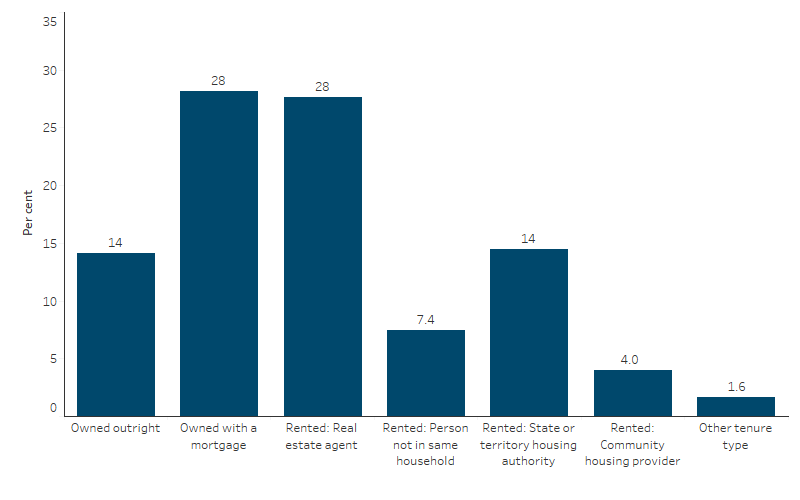
According to data from the ABS Census of Population and Housing, in 2021, 28% (96,600) of First Nations households owned their home with a mortgage, 14% (48,500) owned their home outright, 56% (192,700) were renting, and other tenure accounted for the remaining 1.6% (5,600) (Table D2.01.15).
In 2021, over half (56% or 192,700) of First Nations households were renting. Around a third (35%, 120,200) of households were renting privately, consisting of:
- people renting their home through a real estate agent (94,800, or 28% of all First Nations households)
- renting through someone else outside their household (25,500, or 7.4%).
A further 18% (63,300 households) were living in social housing – consisting of:
- people renting with a state or territory housing authority (14% or 49,500 households)
- people renting with a community housing provider (4.0% or 13,700 households).
A further 2.7% (9,200 households) had another type of landlord or did not state their landlord type (Table D2.01.15, Figure 2.01.1).
The proportion of First Nations households who owned their home increased slightly over the last 3 Censuses - from 37% in 2011, to 40% in 2016, and 42% in 2021. The proportion of households who were renting decreased from 61% in 2011, to 59% in 2016, and 56% in 2021 (Table D2.01.20).
The proportion of households that owned their own home (with or without a mortgage) in 2021 was lower for First Nations households than for other households (42% compared with 68%) (Table D2.01.15). However, the gap in the home ownership rate between First Nations and other households narrowed between 2011 and 2021, from 32 to 26 percentage points (Table D2.01.20).
Figure 2.01.1: Tenure type of First Nations households, Australia, 2021
Source: Table D2.01.15. AIHW analysis of ABS Census of Population and Housing 2021 (ABS 2022a).
Housing tenure for First Nations households also varied by jurisdiction and remoteness. However it should be noted that in many Remote and very remote areas much of the land is held communally rather than by individuals through various First Nations land rights legislation and the Native Title Act 1993 (Cth) (ANAO 2010). Communal-title lands, often found in remote First Nations settlements, are jointly held in some form of a trust for the broader ‘community’ (Memmott et al. 2009). Note that this also affects comparisons by state and territory, reflecting different remoteness distributions.
Noting the above caveat, in 2021, Tasmania had the highest proportion of households with a home that was owned outright (21%; 3,000 households) or owned with a mortgage (36%; 5,300). The Northern Territory had the lowest proportions (6.5% (960) and 17% (2,500), respectively) (Table D2.01.17).
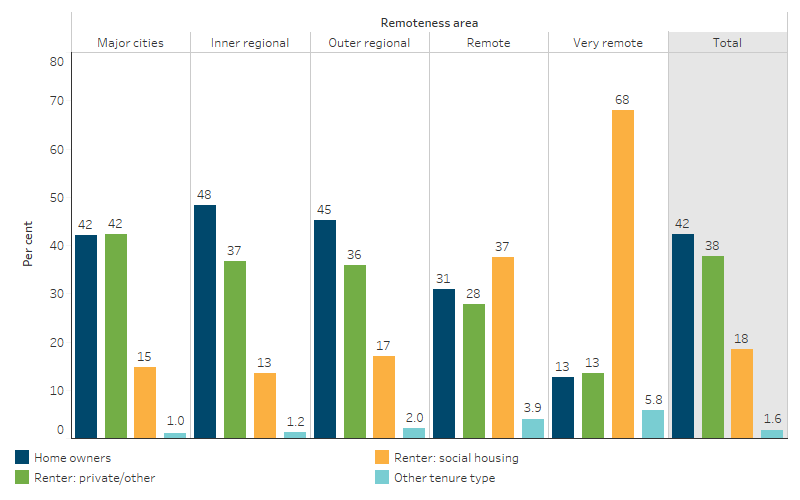
In 2021, First Nations households in non-remote areas had higher rates of home ownership (with or without a mortgage) than those in remote areas (44% (138,500) households compared with 21% (6,600)) (Table 2.01.18). Across 5 remoteness areas, First Nations households in Inner regional areas had the highest proportion of home ownership (48%; 43,600 households). This was followed by First Nations households in Outer regional areas (45% (27,500) total home ownership) (Table D2.01.18, Figure 2.01.2).
First Nations households in Very remote areas had the highest rate of renting in 2021 (82%; 14,000 households). In Very remote areas, 68% (11,700) of First Nations households were renting from a social housing provider – 48% (8,200) from a state or territory housing authority, and 20% (3,500) from a community housing provider (Table D2.01.18, Figure 2.01.2).
While a less common occurrence, certain communal-title lands lie within the boundaries of several regional towns and metropolitan cities in Australia; in some cases, these consist of conglomerates of freehold title blocks held collectively through a community housing organisation (Memmott et al. 2009).
Figure 2.01.2: Tenure type of First Nations households, by remoteness, 2021
Notes:
1. 'Renters: Private/other' includes renting from a real estate agent, a person not in same household, other landlord type and landlord type not stated.
2. 'Renters: social housing' includes renting from a state or territory housing authority or a community housing provider.
Source: Table D2.01.18. AIHW analysis of ABS Census of Population and Housing 2021 (ABS 2023a).
Household composition and tenure type
The 2021 Census showed that there were 352,000 First Nations households, of which around:
- 260,400 (74%) were one family households – consisting of 104,400 (30% of all households) couple families with children, 62,800 (18%) couple families without children, 86,100 (24%) one parent families, and 7,000 (2.0%) other one family households
- 19,000 (5.1%) were multiple family households
- 54,700 (16%) were lone person households
- 19,000 (5.4%) were group households (AIHW analysis of ABS 2022a).
In 2021, 46% of First Nations one family households owned their home (with or without a mortgage). However, the rate of home ownership in this group was different depending on the type of one family household. Over half of First Nations one family households consisted of couple families who owned their home with or without a mortgage (57% of couple families with children, and 58% of couple families without children), compared with one-quarter of one parent family households.
For First Nations households consisting of multiple families, the home ownership rate was 47%, while for group households it was 25%. Among First Nations lone person households, the home ownership rate was 29% (AIHW analysis of ABS 2022a & 2022b).
Housing affordability
One measure of housing affordability is to compare housing costs to gross household income. A household is considered to be in housing stress if housing costs such as mortgage repayments or rent are more than 30% of household income, and the household is in the bottom 40% of the equivalised income distribution (income adjusted by household needs). However, there are many reasons that people may spend more than 30% of gross income on housing costs, other than financial stress – for example, people with higher incomes may choose to spend more than this on housing.
Based on data from the ABS 2021 Census of Population and Housing, 14% (around 11,800 of households for which housing costs as a proportion of income could be determined) of First Nations households who owned their home with a mortgage were spending more than 30% of their gross income on mortgage repayments, a slightly smaller proportion than among other households (16% or 457,000 households) (Table 2.01.33, Table 2.01-1). Among First Nations households who were renting, just over 1 in 3 (35% or about 58,900 households) were spending more than 30% of their gross income on rent payments, the same proportion to that of other households (35% or 856,500 households).
The proportion of First Nations households who owned their home with a mortgage and were spending more than 30% of their gross income on mortgage repayments was lower in more remote areas – ranging from 15% (6,200 households) in Major cities to 12% (80 households) in Very remote areas. A larger difference by remoteness was observed for renters. Among First Nations households who were renting, the proportion spending more than 30% of their gross income on housing costs was 38% in both Major cities (31,100 households) and Inner regional (15,500) areas, compared with 32% (9,000) in Outer regional areas, 24% (1,800) in Remote areas, and 13% (1,500) in Very remote areas (Table D2.01.33). Note that in many Remote and Very remote areas much of the land is held communally rather than by individuals (ANAO 2010), which may influence geographic variation in housing affordability.
Table 2.01-1: Mortgage and rent repayments as a proportion of household income by jurisdiction, First Nations households, 2021
|
Mortgage repayments more than 30% of household income
Number |
Mortgage repayments more than 30% of household income
Per cent of all households |
Rent repayments more than 30% of household income
Number |
Rent repayments more than 30% of household income
Per cent of all households |
|
|---|---|---|---|---|
|
NSW |
4,848 |
15.2 |
23,944 |
40.3 |
|
Vic |
1,282 |
14.7 |
5,271 |
33.9 |
|
Qld |
2,868 |
13.0 |
17,008 |
32.6 |
|
WA |
1,263 |
16.3 |
5,092 |
31.6 |
|
SA |
587 |
12.9 |
3,289 |
34.1 |
|
Tas |
510 |
11.0 |
2,130 |
38.2 |
|
ACT |
129 |
9.4 |
540 |
23.6 |
|
NT |
274 |
13.4 |
1,586 |
18.3 |
|
Australia |
11,765 |
14.2 |
58,867 |
34.7 |
Notes:
1. Data on mortgage repayments relates to occupied private dwellings owned with a mortgage or being purchased under a shared equity scheme. Excludes households where housing costs as a proportion of income could not be determined.
2. Data on rent payments relates occupied private dwellings being rented. Excludes households where rental payments as a proportion of household income could not be determined.
Source: Table 2.01.33. AIHW analysis of ABS Census of Population and Housing 2021 (ABS 2022a).
Appropriately sized housing
The 2021 Census of Population and Housing provides information on the number of First Nations people that are living in appropriately sized (not overcrowded) housing, as well as the number of households living in appropriately sized (not overcrowded) housing. Data for both are presented in this section but note that Target 9a of the National Agreement on Closing the Gap is monitored using data that counts people.
In 2021, 81% (569,400) of First Nations people lived in appropriately sized housing. This was an increase from 75% in 2011 (Table D2.01.12).
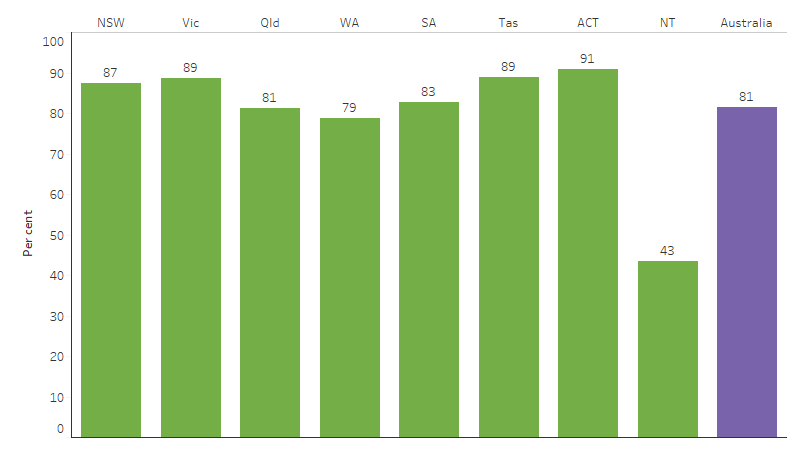
Across states and territories, the proportion of First Nations people who lived in appropriately sized housing ranged from 43% (22,600) in the Northern Territory to 91% (7,100) in the Australian Capital Territory (Table D2.01.9, Figure 2.01.3).
The proportion of First Nations people living in appropriately sized housing was lower than for non-Indigenous Australians nationally (81% (569,400) compared with 94% (20.1 million), respectively) (Table D2.01.9). First Nations people were 2.9 times as likely to live in an overcrowded dwelling as non-Indigenous Australians nationally, with the rate across jurisdictions ranging between 1.5 times as high in New South Wales, to 6.1 times as high in the Northern Territory (Table D2.01.9).
Figure 2.01.3: Proportion of First Nations people living in appropriately sized (not overcrowded) housing, by jurisdiction, 2021
Source: Table D2.01.9. AIHW analysis of ABS Census of Population and Housing 2021 (ABS 2022a).
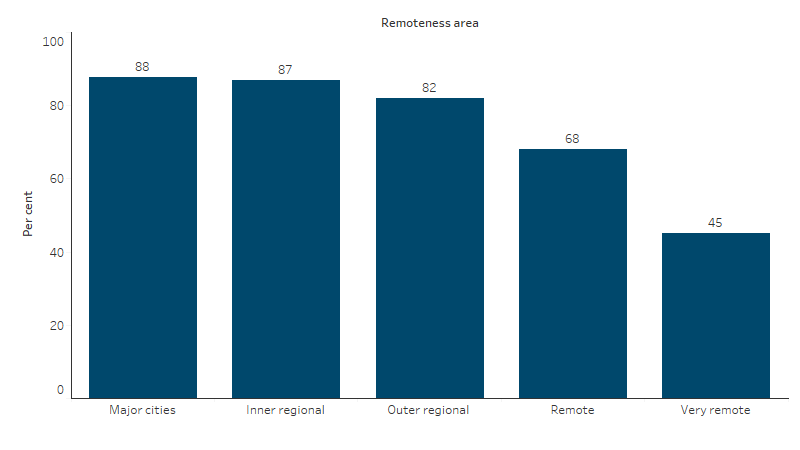
First Nations people in remote areas had higher rates of household overcrowding than those in non-remote areas. In 2021, the proportion of First Nations people living in appropriately sized housing ranged from 88% (294,200) in Major cities to 45% (65,300) in Very remote areas (Figure 2.01.4). For non-Indigenous Australians, the proportion living in adequately sized housing ranged from 93% (16 million) in Major cities to 95% (1.5 million) in Outer regional areas (Productivity Commission 2023b).
Figure 2.01.4: Proportion of First Nations people living in appropriately sized (not overcrowded) housing, by remoteness area, 2021
Source: Table D2.01.10. Productivity Commission analysis of ABS Census of Population and Housing 2021 (Productivity Commission 2023b).
Looking at data for households, in 2021, 90% (297,700) of First Nations households were appropriately sized (not overcrowded), compared with 97% of other households (Table D2.01.10). The proportion of First Nations households that were appropriately sized increased from 87% to 90% between 2011 and 2021 (ABS 2022b).
The proportion of First Nations households that were appropriately sized ranged from 93% (142,100) in Major cities to 69% (11,500) in Very remote areas (Table D2.01.10, Figure 2.01.3).
Severe overcrowding refers to dwellings that require 4 or more additional bedrooms to accommodate the people who usually live there and is considered a form of homelessness (see also Homelessness). The proportion of First Nations households that were severely overcrowded was highest in Very remote areas, at 5.6% (933 of 16,800 households), followed by Remote areas (1.5%, 202 of 13,800 households). In non-remote areas, 0.1% (433 of 298,500) of First Nations households were severely overcrowded (Table 2.01.10).
For other households, the proportion of households in appropriately sized housing was more consistent across remoteness areas, ranging from 96% to 98% across the 5 areas (Table D2.01.10). The proportion of other households that were severely overcrowded was 0.06% or less across all remoteness areas (Table 2.01.10).
According to the 2022–23 National Aboriginal and Torres Strait Islander Health Survey (NATSIHS), First Nations people aged 15 and over were more likely to report living in overcrowded households if they:
- were unemployed, compared with those who were employed (2.6 times, 23.6% compared with 9.1% respectively).
- were a renter, compared with those who owned their home (2.3 times, 17.4% compared with 7.4% respectively).
Based on NATSIHS, factors that were associated with First Nations people living in appropriately sized housing were:
- financial security – 8.3% of those who reported being able to raise $2,000 in a week experienced overcrowding, compared with 18.3% of those who could not
- educational attainment – 9.5% of those who had a non-school qualification experienced overcrowding, compared with 18.2% of those who did not (Table D2.01.3).
Housing assistance
The Australian and state and territory governments provide a range of assistance to people having difficulty with finding or sustaining affordable and appropriate housing in the private housing market. Housing assistance refers to both access to social housing (such as public housing) as well as targeted financial assistance for eligible Australians.
For up-to-date data on Housing Assistance see Housing assistance in Australia, About - Australian Institute of Health and Welfare.
Social housing
Social housing dwellings data are provided by state and territory housing authorities. At 30 June 2024, there were around 452,000 social housing dwellings in Australia (AIHW 2025d).
Data on Indigenous status of the household is collected for public housing, community housing and stated owned and managed Indigenous housing (SOMIH). For Indigenous community housing, this information is unavailable. Throughout this measure, all households living in Indigenous community housing have been assumed to be First Nations households.
At 30 June 2024, there were around 84,400 First Nations households living in one of the 4 main types of social housing:
- 40,700 in public housing
- 14,700 in SOMIH
- 11,500 in community housing
- 17,600 in Indigenous community housing (AIHW 2025d).
At 30 June 2024, nearly 1 in 5 (19%) First Nations households in public housing had been in the same tenure for a decade or more. In SOMIH, 37% of First Nations households had been in the same tenure for more than a decade, and 13% for those in community housing (AIHW 2023b, 2025d). Information on tenure is unavailable for Indigenous community housing.
Financial assistance
Commonwealth Rent Assistance (CRA) is the most common form of housing assistance received by Australian households. CRA is a payment provided to eligible families and individuals who pay, or are liable to pay, private rent or community housing rent. CRA is paid at 75 cents for every dollar above a minimum rental threshold until a maximum rate is reached. The minimum threshold and maximum rates vary according to the household or family situation, including the number of children (Services Australia 2025).
CRA recipients are classified as ‘income units’, rather than households. An income unit can be an individual, or a group of related persons within a household, whose command over income is shared, or any person living in a non-private dwelling who is in receipt of personal income. There can be more than one income unit per household. For this section, the term CRA recipients is used instead of income units.
For up-to-date data on CRA recipients see Commonwealth Rent Assistance in Australia: quarterly data, Rental stress and Commonwealth Rent Assistance - Australian Institute of Health and Welfare.
At 30 September 2025, 108,770 CRA recipients reported having a First Nations member (7.8% of all recipients).
CRA helps to reduce rental stress (with rental stress defined as spending more than 30% of gross income on rent). In September 2025, without CRA, 78,760 (74%) recipients with a First Nations member would have been in rental stress. However, 40,190 (38%) First Nations CRA recipients were still in rental stress after receiving CRA.
The proportion of CRA recipients with a First Nations member who were in rental stress after receiving CRA payments increased from 30% in 2013 to 33% in 2019, then fell substantially to 19% during 2020, before increasing to 38% in 2025. It is important to note that in 2020 the calculation of rental stress included the temporary Coronavirus Supplement (AIHW 2025d).
Homelessness
Estimates from the 2021 ABS Census indicate that around 24,900 (3.1%) of First Nations people were experiencing homelessness on Census night (ABS 2023a).
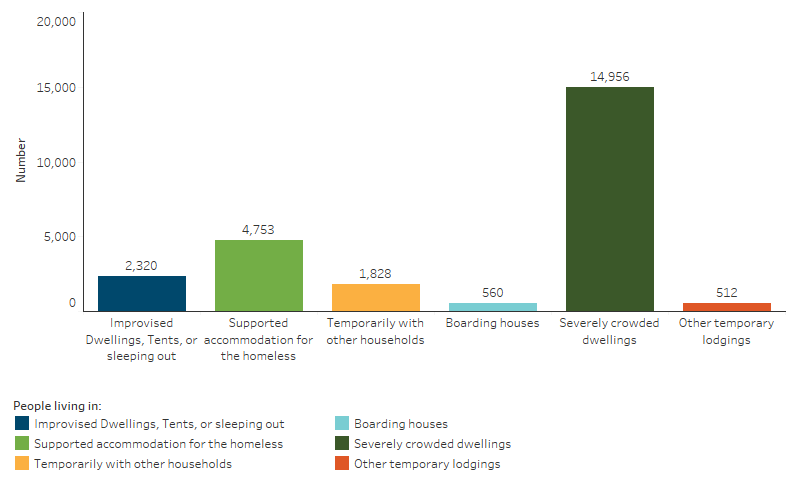
The ABS distinguishes between 6 broad groups of people experiencing homelessness according to the living situation of the person at the time (see Figure 2.01.5).
Of First Nations people experiencing homelessness at the time of the 2021 Census, about:
- 15,000 (60% of all First Nations people experiencing homelessness) were living in ‘severely’ crowded dwellings (dwellings needing 4 or more extra bedrooms under CNOS)
- 4,800 (19%) were in supported accommodation for the homeless
- 2,300 (9%) were living in improvised dwellings, tents, or sleeping out (Figure 2.01.5).
Figure 2.01.5: First Nations people experiencing homelessness, by homeless operational group, 2021
Source: ABS Census of Population and Housing data (ABS 2023a).
Across states and territories in 2021:
- Among First Nations people experiencing homelessness in the Northern Territory, Queensland and Western Australia, people living in ‘severely’ crowded dwellings were the largest group, accounting for 85%, 52% and 46% of the First Nations population experiencing homelessness in each jurisdiction, respectively.
- People living in supported accommodation for the homeless accounted for the largest group of First Nations people experiencing homelessness in four jurisdictions – the Australian Capital Territory (where 71% of First Nations people experiencing homelessness lived in supported accommodation), Victoria (56%), South Australia (47%) and New South Wales (33%).
- In Tasmania, people staying temporarily with other households accounted for the largest proportion of the First Nations population experiencing homelessness in this jurisdiction (33%), followed by those in supported accommodation for the homeless (28%) (AIHW analysis of ABS 2023a).
From 2011 to 2021, the number of First Nations people who were experiencing homelessness decreased from around 26,700 to 24,900. Using population rates, which account for population growth, the rate of homelessness among the First Nations population declined from 487 to 307 First Nations persons experiencing homelessness per 10,000 population. This was driven by a decline in the number of First Nations people living in severely overcrowded dwellings, which decreased from around 20,100 in 2011 to 15,000 in 2021 (ABS 2023b).
In 2021, First Nations people accounted for 23% of the national population experiencing homelessness (excluding people for whom Indigenous status was not stated). The rate of homelessness among First Nations people was 8.8 times the rate for non-Indigenous Australians (307 compared with 35 per 10,000 population). The gap in homelessness rates between First Nations people and non-Indigenous Australians decreased between 2011 and 2021 (from 453 to 272 per 10,000 population) (ABS 2023a & AIHW analysis of ABS 2023a).
Use of specialist homelessness services
Specialist homelessness agencies provide a wide range of services to assist people who are experiencing homelessness or who are at risk of homelessness, ranging from general support and assistance to immediate crisis accommodation (AIHW 2025f).
For up-to-date data on use of specialist homelessness services see Specialist homelessness services annual report - Australian Institute of Health and Welfare. Note that rates published in this measure are crude unless specified otherwise, and so may not match those published in other AIHW reports.
Around 366,300 First Nations clients have been supported by homelessness agencies since the Specialist Homelessness Services Collection (SHSC) began in July 2011. In 2023–24, around 78,300 First Nations clients received support from specialist homelessness services (SHS). Of these, approximately 62% (48,800) were female and 19% (15,100) were children aged 0–9 (AIHW 2025f).
In 2023–24:
- There were 760 First Nations SHS clients per 10,000 population nationally. That is, around 8% of the First Nations population used specialist homeless services.
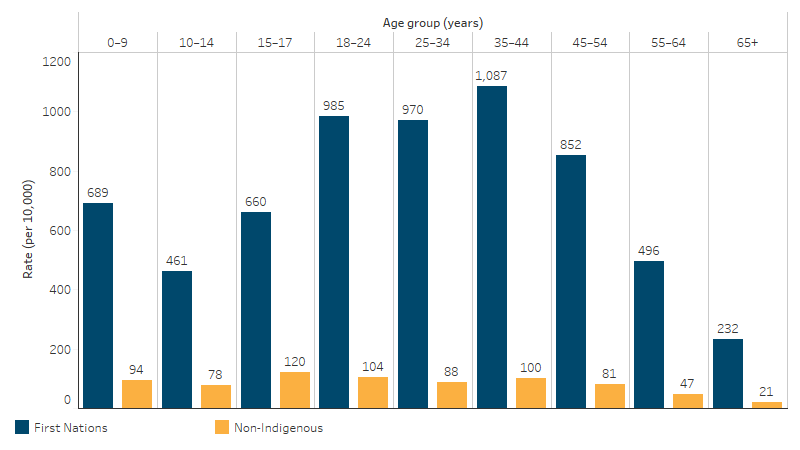
- First Nations people aged 35–44 had the highest rate of specialist homelessness services use (1,087 clients per 10,000 population), followed by those aged 18–24 (985 clients per 10,000) and 25–34 (970 per 10,000).
- Across age groups, the rate of specialist homelessness services use for First Nations people ranged from 5.5 to 11.1 times as high as for non-Indigenous Australians (Table D2.01.21, Figure 2.01.6).
- First Nations people used specialist homelessness services at 9.4 times the rate of non-Indigenous Australians (age-standardised rate of 746 compared with 80 per 10,000 population) (Table D2.01.30).
Figure 2.01.6: Specialist homelessness services clients, by Indigenous status and age, 2023–24
Source: Table D2.01.21. AIHW Specialist Homelessness Services Collection 2023–24.
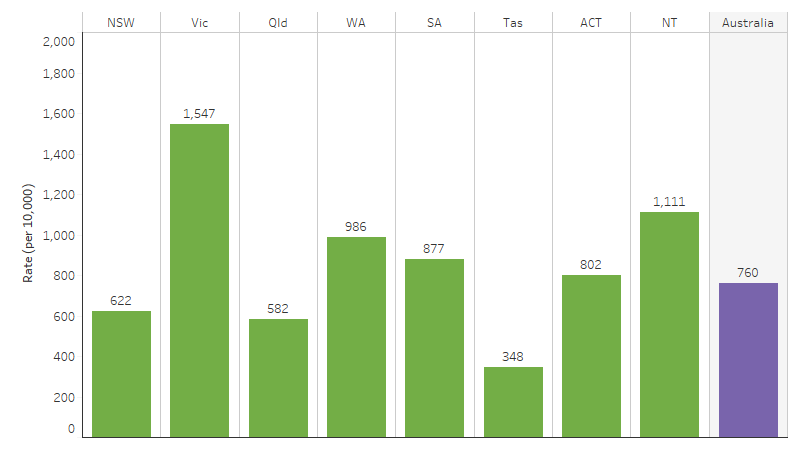
In 2023–24, New South Wales had the largest number of First Nations people receiving support from SHS with 22,100 First Nations clients, followed by 16,800 in Queensland. In the Northern Territory, 88% (8,700) of SHS clients were First Nations people, the largest proportion in all jurisdictions. Rates ranged from 1,547 per 10,000 population in Victoria to 348 per 10,000 in Tasmania (Table D2.01.30, Figure 2.01.7).
Figure 2.01.7: Specialist homelessness services clients, First Nations people, by jurisdiction, 2023–24
Source: Table D2.01.30. AIHW Specialist Homelessness Services Collection 2023–24.
In 2023–24, more than half of First Nations clients (59%, or 46,400 clients) presented to homelessness services alone, and a further 32% (24,900 clients) presented as a single person with children (Table D2.01.22).
The 3 most common reasons why First Nations clients sought assistance from SHS agencies in 2023–24 were:
- family and domestic violence (24% or 19,000 clients)
- housing crisis (17% or 13,000 clients)
- inadequate or inappropriate dwelling conditions (14% or 11,100 clients) (Table D2.01.31).
Of the 38,300 First Nations clients who were experiencing homelessness at the beginning of their first support period:
- 39% had been living in short-term temporary accommodation
- 26% had been ‘couch surfing’, and
- 17% had been living without shelter (Table D2.01.32) (AIHW 2025f).
Housing situation outcomes for SHS clients
In 2023–24, for First Nations clients with closed support period, the proportion experiencing homelessness decreased from 48% (25,500) at the start of support to 38% (19,300) at the end. More First Nations clients were also living in housing with some form of tenure at the end of the support period, mainly due to an increase in the number of clients living in public or community housing (from 30% (15,600) to 38% (19,600)) (AIHW 2025f). Note: This information is limited only to clients who have stopped receiving support during the financial year, and who were no longer receiving ongoing support from a SHS agency.
In 2023–24, 79% (13,800) of First Nations SHS clients who were at risk of homelessness within the first 6 months of the financial year were assisted to avoid homelessness over the following 6 months – a 3.0 percentage point increase since 2018–19 (AIHW 2024).
Among First Nations SHS clients who had at least one support period with a monthly housing status of ‘homeless’ during 2023–24, 12,500 were experiencing persistent homelessness – that is, they had been experiencing homelessness for more than 7 months over a 24-month study period (AIHW 2024). This was an increase from around 8,000 First Nations clients experiencing persistent homelessness in 2018–19.
SHS use over time –a cohort analysis
Using the specialist homelessness services longitudinal data set, analysis of a cohort of adult First Nations clients in 2015–16 was undertaken to examine SHS support patterns for this cohort of service users (AIHW 2022). The First Nations 2015–16 cohort was defined as clients who received a service in 2015–16 and longitudinal analyses was performed over the period 2011–12 to 2020–21. There were 38,600 clients in the adult First Nations 2015–16 cohort, and these clients had the following key characteristics:
- Less than 20% were aged 45 or over.
- Nearly half (19,000 clients) had only one support period during the defining study period and 28% (10,800) had 3 or more support periods.
- Half (19,400 clients) were experiencing housing crisis (a reason for seeking assistance) and 44% (17,200) were experiencing financial difficulties.
- Over half (56%) had received SHS support previously; that is, 21,600 clients received SHS support in the 48-month retrospective period that preceded the defining study period.
- Over 23,000 clients (60%) continued to receive support into the future; that is, they received support in the 48 months after the 12-month defining study period.
- One in 5 (20% or 7,700) First Nations cohort clients received short-term accommodation in the defining period and needed short-term accommodation again in the prospective period.
First Nations clients were also more likely to have presented with children and need short-term or emergency accommodation than non-Indigenous clients. They were also more likely to have experienced homelessness and to be long-term clients. Client traits or experiences, as reported during the defining study period, associated with either a history of or future SHS support include having transitioned from custody, experiencing family and domestic violence or problematic drug/alcohol issues (AIHW 2022).
Research and evaluation findings
Despite national improvements in home ownership rates and reductions in the overall rate of homelessness among First Nations people, significant challenges remain (AIHW 2025e). These improvements are not uniform across jurisdictions, with some areas experiencing increases in housing instability and homelessness rates. The research explores various aspects of housing and its impact on health and wellbeing, which are detailed below:
- Housing instability (frequent moves), renting a home rather than owning it, and rental and mortgage stress (difficulty paying rent or mortgage) have been shown to negatively affect children’s physical health, learning outcomes and social and emotional wellbeing (Dockery et al. 2013; Nikolof et al. 2023).
- Poor housing conditions and overcrowding – Health implications associated with poor housing conditions can arise from overcrowding, an insufficient supply of housing, inappropriate housing, and lack of community infrastructure that supports clean air, clean water and sanitation (Clifford et al. 2015).
These environmental factors are linked to increased rates of respiratory diseases, trachoma, skin infections and Group A Streptococcus bacterial infections which can lead to acute post-streptococcal glomerulonephritis, acute rheumatic fever and further complications such as rheumatic heart disease (AIHW 2023a; Ali et al. 2018; Cannon and Bowen 2021; Clifford et al. 2015; Lansbury et al. 2024; Lorentzen et al. 2022). Additionally, poor housing is associated with chronic and cardiometabolic diseases, including heart disease and diabetes (Chakraborty et al. 2022; Chakraborty et al. 2021). A study examined the impact of overcrowded housing on the health of First Nations people in New South Wales, it found that for every 1% increase in crowded households, there was an increase of 130 avoidable hospital admissions per 100,000 people (Doyle et al. 2024).
Overcrowding specifically places additional pressure on household facilities and infrastructure, limiting residents’ ability to engage in healthy living practices (Bailie and Wayte 2006). Furthermore, multiple studies have shown that overcrowded housing contributes to increased COVID-19 infection rates and a higher mortality (Aldridge et al. 2021; Varshney et al. 2022). (see measures 1.15 Ear Health, 1.16 Eye health, 1.06 Acute rheumatic fever and rheumatic heart disease, and 2.02 Access to functional housing with utilities)
- Homelessness – Research highlights the complex interrelationships between homelessness and various social, economic, and health-related factors. People experiencing homelessness face significantly higher rates of chronic illness and death compared with the general population. Common health issues include malnutrition, dental problems, and chronic conditions exacerbated by unstable living conditions. Homelessness is also linked to increased exposure to violence and victimisation, long-term unemployment, and social isolation (AIHW 2025b). There are also strong interrelationships between homelessness and mental health. While a mental health episode can trigger homelessness, the isolation and trauma of homelessness (in particular that associated with rough sleeping) can also precipitate mental illness (Brackertz et al. 2018).
- Home ownership and affordability – Home ownership provides significant stability and security for all Australians, including First Nations people. Housing affordability is a significant issue across various types of tenure in Australia, which has an impact on First Nations communities. A lack of affordable housing can create stress, affecting individuals' sense of stability and control in their lives. Secure and affordable housing is crucial for both mental and physical health (AIHW 2025e). First Nations people face many barriers to home ownership and in sustaining rental tenancies, such as low income, cultural obligations to accommodate extended families with housing needs, geographical location, and communal land tenure (Moskos et al. 2022). The difficulties First Nations households have in accessing safe, secure and affordable housing are known, yet policy has been slow to develop effective strategies in addressing these issues (Moskos et al. 2025).
The study Indigenous Housing Support in Australia: The Lay of the Land reveals significant and persistent gaps in affordable and appropriate housing for First Nations households. In 2021, 1 in 8 First Nations households experienced unmet housing needs – nearly double the rate for all Australian households. The majority (81%) of these unmet needs were due to unaffordable rental housing, with 79% of very low-income First Nations households experiencing rental stress. Severe overcrowding accounted for 14% of unmet needs, particularly in social housing, while 4% were due to inadequate housing conditions. Around one-quarter of First Nations households relied on social housing, and they represented over 30% of new public housing tenancies. There are significant variations in the patterns of unmet need among First Nations households by location and origin of need. Areas with the greatest levels of unmet need include many parts of New South Wales and Queensland, where rental stress is concentrated, and remote Australia, where much of the unmet need arises from overcrowding in social housing. To meet both current and projected demand, the report estimated that social housing stock must grow by nearly 4% annually, equivalent to 3,600 additional dwellings each year over the next two decades. The report also highlights broader systemic issues: the absence of a national First Nations housing strategy, the decline of First Nations community-controlled housing providers in most jurisdictions, and the limited financial capacity of the sector to expand housing supply (Moskos et al. 2025).
The report on Sustainable Indigenous Housing in Regional and Remote Australia defines sustainable housing for First Nations communities as housing that promotes health and wellbeing while maintaining high standards over time. Key pillars of sustainability include climate adaptation, life-cycle costing, local employment, and health and wellbeing. Climate adaptation is essential to ensure housing can withstand the impacts of climate change and provide comfortable indoor environments. However, this is currently not the case across much of the housing available to First Nations people. Many homes are ill-equipped to handle extreme heat and other climate-related stressors, which negatively affect health and wellbeing outcomes. Life-cycle costing helps reduce long-term maintenance expenses by prioritising durable materials and efficient design. Local employment in housing construction and maintenance supports economic development and community empowerment but these benefits are under-realised (Lea et al. 2021).
The 2025 State of the Housing System report identified persistent housing challenges for First Nations people, including a shortage of suitable housing and overrepresentation in unstable or marginal areas of the housing system. A high proportion of First Nations people experience homelessness, most commonly due to overcrowding. Home ownership (although improving) is substantially lower than for non-Indigenous Australians, and housing is often substandard, particularly in remote areas. In 2022–23, 36% of First Nations households in remote areas lived in dwellings that did not meet acceptable standards, defined as lacking basic facilities or having two or more major structural problems. The report also noted that many homes in these areas are not built to withstand extreme temperatures, natural hazards or the growing impacts of climate change. Fragmented housing policy, funding, and data collection continue to limit coordinated responses. These challenges for First Nations housing are exacerbated by cultural and geographic factors, with current funding models failing to account for the complexity of delivering housing in First Nations contexts (ABS 2022b, 2024; NHSAC 2025; Quilty and Jupurrurla 2022).
Findings from the House of Representatives Standing Committee Inquiry into Homelessness in Australia recommended a review of homelessness data collection and estimation methods. The inquiry recommended greater inclusion of First Nations’ cultural practices and perspectives, particularly regarding the circumstances in which persons living in severely crowded dwellings and boarding houses are categorised as homeless. The findings also highlight the effectiveness and appropriateness of Aboriginal community-controlled housing services, and recommended the development of a national integrated approach to housing and homelessness services for First Nations people, co-designed with Aboriginal community controlled organisations (ACCHOs) and grounded in the principle of self-determination (HRSC 2021).
The 2022 review of the National Housing and Homelessness Agreement (NHHA), which came into effect on 1 July 2018, found that the agreement had been largely ineffective in improving housing affordability and fostering meaningful collaboration between governments (Productivity Commission 2022). The review highlighted that housing affordability has deteriorated for many people, especially people renting in the private market. With the private market becoming less affordable, demand for homelessness services and social housing is rising. To address these challenges, the review recommended several key reforms: prioritising private rental affordability, improving the targeting of housing assistance, setting firm targets for new housing supply, and reviewing the adequacy and targeting of Commonwealth Rent Assistance. While First Nations people were identified as a national priority cohort under the NHHA (Council on Federal Financial Relations 2018), the review highlighted the need for more targeted and effective measures to meet their housing needs. The NHHA has been replaced by the National Agreement on Social Housing and Homelessness (NASHH), see Implications for more information.
An exploratory study examined the impact population mobility has on housing and community infrastructure needs. Remote communities are impacted by both temporary and long-term population mobility. Drivers of temporary mobility included seasonal factors such as school holidays and weather patterns, as well as more unanticipated factors such as cultural business and sorry business, sports events and shows, and also for some people (particularly following changes to employment policies around compulsory activity requirements) mobility out of dry communities to seek alcohol. Return to Country programs during the COVID-19 pandemic also brought people back to communities. Factors affecting both temporary and longer-term population mobility included access to housing, infrastructure, services, employment, and social factors such as family conflict and community instability. Overcrowding and limited accommodation options discourage people from returning to live in remote communities and act as a driver for community members to move elsewhere. Overcrowding could also adversely impact upon household members regarding health, employment, education, child protection issues and domestic violence outcomes, placing further pressure on local services (Moskos et al. 2024). The review also cited earlier research that some First Nations people who choose to live in public spaces or ‘sleeping rough’ may not identify as homeless, reflecting different cultural understandings of home and shelter, and this in turn results in differing views on homelessness and its solutions (Memmott et al. 2003; Pearson et al. 2021).
Recent Australian research continues to highlight that First Nations people's experiences of homelessness and overcrowding often differ from how these issues are captured in standard statistical definitions. Overcrowding in housing is commonly assessed in Australia using the Canadian National Occupancy Standard (CNOS), which defines overcrowding based on the number of bedrooms required for a household’s composition. While CNOS is widely used in national housing statistics, it may not fully capture the cultural and behavioural nuances of First Nations households. First Nations living arrangements often include extended family networks, shared caregiving responsibilities, and cultural obligations to host visitors – particularly those travelling between remote communities and urban centres. These practices reflect strong kinship ties and communal living preferences, which may result in larger household sizes that are not necessarily indicative of housing stress from a First Nations perspective. As such, housing classified as overcrowded (under CNOS) may nevertheless be culturally appropriate and preferred. The study How many in a crowd? Assessing overcrowding measures in Australian housing found that CNOS does not adequately account for these cultural norms or the capacity of households to manage higher occupancy. The study recommends that overcrowding measures be reframed to include subjective experiences of crowding, household functioning, and culturally specific indicators – particularly for First Nations households (Dockery et al. 2022). Maintaining a large, open household is central for many First Nations people, driven by a culture of sharing and family connection (Memmott et al. 2011). Housing must be compatible with local cultural practices, including kinship rules, which can influence the layout and proximity of dwellings. Research shows that a ‘one size fits all’ approach is a key reason for the ongoing failure of governments and agencies in providing appropriate housing for First Nations people (AHURI 2018).
Research continues to highlight the ongoing challenges in addressing overcrowding in remote areas of Australia. According to a 2022 report by the Australian National Audit Office, overcrowding remains a significant issue, particularly in the Northern Territory. As of September 2021, 54% of houses in remote First Nations communities in the Northern Territory were considered overcrowded (ANAO 2022). The report emphasised that despite progress, substantial efforts are still required to meet housing needs. The Northern Territory Housing Strategy 2020–2025 also highlights the need for additional housing to address overcrowding. It estimates that thousands of new dwellings are required to meet current and future demands (Department of Local Government‚ Housing and Community Development 2019). This aligns with the earlier projection that an additional 5,500 homes are needed by 2028 to reduce overcrowding to acceptable levels, with half of this need in the Northern Territory (Towart et al. 2017).
In Queensland, the Aboriginal and Torres Strait Islander Housing Action Plan 2019–2023 was developed in partnership with First Nations communities to address the unique and intersecting barriers to housing and homelessness. According to the final report, 10 of the 15 actions have been completed or are in ongoing delivery, resulting in significant improvements in housing conditions and health outcomes. The remaining five actions will continue under Our Place: A Housing and Homelessness Action Plan 2024–2027. Despite challenges such as the COVID-19 pandemic and severe weather events, the program showed the effectiveness of culturally appropriate, community-led housing solutions in enhancing wellbeing (Queensland Government n.d.).
The Housing for Health (HFH) program is a long-running initiative designed to improve the safety and health of First Nations community housing by ensuring that essential ‘health hardware’ – such as functioning showers, toilets, and electrical systems – is in good working order. A recent evaluation of the program in New South Wales highlighted significant improvements in the health and safety of First Nations housing by addressing 11 critical ‘Healthy Living Practices’ (for example safety, facilities for washing people and clothes, removing waste and preparing food). Data from 3,670 houses showed significant improvements in the ability of the houses to support safe and healthy living for all critical healthy living priorities post-interventions. However, the evaluation also found that the overall condition of health-related hardware before intervention had not significantly improved over the past 20 years, caused by a systematic lack of routine maintenance and quality control (Standen et al. 2020).
In the Northern Territory, the Healthy Homes program aimed to improve housing conditions in remote First Nations communities through preventive and cyclical maintenance, tenancy support, and HFH projects. An independent evaluation found that while HFH projects improved housing functionality, they covered only a small proportion of remote communities. Just 24% of dwellings received the required Condition Assessment Tool (CAT) inspections, limiting the program’s preventive impact. Short contract durations, inconsistent data collection, and poor integration of inspection findings into asset management systems further reduced effectiveness. The evaluation recommended improvements in contract design, interdepartmental coordination, and data systems to better support housing outcomes (Grealy et al. 2023).
The Homelands Housing and Infrastructure Program (HHIP) evaluation for 2022–24 highlights persistent housing challenges in remote Northern Territory First Nations communities despite significant upgrades. The program delivered improvements to 298 houses across 318 homelands, including refurbished kitchens, bathrooms, and laundries, additional bedrooms to reduce crowding, and upgrades to power and water systems. Residents reported better safety and functionality, enabling ‘Healthy Living Practices’ such as washing, food preparation, and safe waste removal. However, systemic issues remain with severe overcrowding, poor thermal performance, and aging infrastructure that continue to undermine health outcomes. Policy restrictions on new housing exacerbate these problems, leaving many families in inadequate dwellings. Community feedback emphasised the need for new and replacement housing, preventive maintenance cycles, and culturally informed design. Recommendations included embedding preventive maintenance, improving transparency in project selection, and prioritising ACCHOs for delivery. Long-term funding certainty and integrated planning were identified as critical to sustaining health gains achieved through housing interventions (Grealy 2025).
Stories from First Nations social housing tenants and La Perouse (New South Wales) community members highlight that ‘home’ is understood as relational – anchored in Country, kinship, and cultural practices – rather than solely as physical shelter. Tenants prioritised remaining near La Perouse for cultural and social wellbeing, alongside needs for safe, healthy housing, stability, accessibility, and adequate space for family. Systemic barriers such as racism, housing shortages, poor housing quality, unactioned repairs and maintenance, and complex provider systems create hazards to health and wellbeing (for example severe and persistent mould in the house). Some tenants also reported mental health impacts and social isolation. In response to communication gaps between tenants and providers, the project co-designed ‘Bundi: A housing tool for mob’, a set of plain-language resources to clarify housing processes and maintenance pathways to support tenants in accessing functional housing and essential utilities (Anderst 2025). Community-led and culturally responsive housing initiatives have demonstrated positive outcomes. The Wreck Bay Home Ownership Program provides an example of co-designed housing upgrades and planning tailored to local needs, improving housing conditions and supporting aspirations for home ownership (Drake et al. 2021a; Drake et al. 2021b).
Bailie and colleagues (Bailie et al. 2011) supported existing Australian and international literature in their claim that housing programs that are focused on improving the functional state of the infrastructure have a limited effect on housing-related health risks, such as domestic hygiene, at the community level. For example, levels of overcrowding may remain high despite improvements to physical infrastructure, enabling poor domestic hygiene to persist. The authors propose hygiene promotion programs as important complementary initiatives to infrastructure improvement projects.
A study of 600 caregivers of 1,406 First Nations children (aged 0–17) in urban New South Wales, as part of Phase One of the Study of Environment on Aboriginal Resilience and Child Health (SEARCH), found that most families lived in social housing (60%), followed by private rentals (21%) and owned homes (19%). Common issues included structural damage, dampness, mildew, vermin, overcrowding, and unaffordability. Social housing tenants reported more physical problems but fewer affordability concerns. In contrast, private renters experienced higher residential mobility. Specifically, children living in private rental were 3.31 times as likely to live in more than four houses since birth as those in homes that were owned. Income level also played a significant role. Families in the lowest income bracket were 10 times as likely to report being unable to keep their home warm in winter and 2.5 times as likely to report feeling crowded as those in the highest bracket (Andersen et al. 2017).
A systematic review examined the impact of high residential mobility on Indigenous children (aged 0–12) in Australia, Canada, and New Zealand. A key theme across all the studies was the multiple and interrelated aspects of housing disadvantage being experienced by Indigenous families. Frequent moves were linked to increased emotional and behavioural difficulties, especially among younger children. Developmental risks increased with the number of homes a child had lived in, showing a pattern of growing vulnerability with each move. However, evidence on physical health and academic outcomes was limited and inconclusive (Nikolof et al. 2023).
Implications
Despite improvements in overcrowding, home ownership and a reduction in homelessness, disparities in remote areas persist. There is a continued need for public policy that aims to ensure access to affordable, safe, and sustainable housing for all First Nations people.
First Nations people remain disproportionately affected by homelessness and are 3 times more likely to live in overcrowded dwellings than non-Indigenous Australians. These housing disparities have far-reaching consequences for health, education, employment, and community connection – key areas of focus under the National Agreement on Closing the Gap. Without culturally appropriate, targeted interventions and improved data collection, progress on housing-related targets is unlikely to be achieved (NHSAC 2024).
While the proportion of First Nations households in social housing declined from 22.5% in 2016 to 18.5% in 2021, the absolute number rose substantially – from 57,480 households in 2016 to 84,490 in 2024 (Productivity Commission 2025b). This increase reflects both population growth and continued efforts to expand access to secure housing.
Social housing and subsidised rental housing provided by not-for-profit, non-government, or government organisations, support those people unable to access suitable housing in the private rental market (Productivity Commission 2025a). There are four forms of social housing available: Public housing, State owned and managed Indigenous housing (SOMIH), Community housing, and Indigenous community housing (ICH). Mainstream public housing and community housing services should support First Nations tenants to achieve and maintain tenancies by recognising cultural values and kinship obligations. Flexible approaches, such as culturally competent housing staff, can reduce evictions and homelessness. The Wongee Mia project exemplifies innovative support for extended families to prevent eviction (Memmott et al. 2016; Vallesi et al. 2020).
The proportion of First Nations people supported through services aimed at preventing homelessness has increased. Several programs in Australia use a ‘Housing First’ approach, prioritising safe, permanent housing as the first priority for people experiencing homelessness as a foundation for addressing other needs (such as drug and alcohol counselling or mental health treatment). International evidence has shown this approach has proven more effective than requiring specialist homelessness services clients to be ‘housing ready’ first, improving housing stability and health outcomes among people with disabilities (Peng et al. 2020). Collaboration between housing, health, and other services is crucial – particularly for First Nations people with experiences of domestic and family violence and/or mental health challenges. Considering the complex nature of these situations, it is critical that the services provided are culturally appropriate.
In non-remote areas, First Nations people face unique challenges with social housing services. Many First Nations households rely on social housing, with 12% living in overcrowded conditions. While efforts are underway to make public and community housing services more culturally sensitive and flexible, overcrowding remains a significant concern. Although homelessness rates among First Nations people have shown signs of decline, they continue to exceed those of non-Indigenous Australians, highlighting the need for ongoing support and culturally appropriate housing solutions. Further research is needed to understand changes in social housing service use and their impacts (AIHW 2025c).
In July 2024, the National Agreement on Social Housing and Homelessness (NASHH) replaced the National Housing and Homelessness Agreement (NHHA). This agreement, involving Australian, state and territory governments, will help people who are experiencing, or at risk of, homelessness and support the effective operation of Australia’s social housing and homelessness services sectors. In the NASHH, First Nations people are the only priority homelessness cohort. The Australian Government is providing around $1.8 billion annually to the states and territories, including $400 million per year for homelessness funding, which the states and territories are required to match. This funding is indexed annually and will total $9.3 billion over five years (2024–2029). The NASHH requires all decisions that predominately affect First Nations people be decided by Partnership bodies for each jurisdiction, made up of appropriate representation from First Nations communities and the jurisdictional government. Beyond funding, the NASHH aims to improve service delivery flexibility, strengthen data and evidence sharing, and enhance transparency and accountability in public spending. Progress is monitored through the National Outcomes Framework (DSS 2024).
Remote housing programs have delivered improvements, but overcrowding remains an issue. Involving communities in the design, construction and maintenance of housing can build capacity for improved housing-related health outcomes (Ware 2013). This development would be consistent with Closing the Gap Priority Reform Two, which focuses on building the community-controlled sector.
The National Aboriginal and Torres Strait Islander Housing Association (NATSIHA) is the first national peak body for First Nations housing. They advocate for culturally appropriate, community-controlled housing solutions for First Nations people. Its core role is to close the housing gap by empowering First Nations-led decision-making, strengthening the capacity of First Nations housing providers, and influencing national policy to ensure safe, secure, and culturally responsive housing outcomes. The Housing Policy Partnership (HPP) involves governments, the Coalition of Peaks, and First Nations representatives to develop First Nations housing policy. The Australian Government has committed $9.2 million starting from 2022–23, to establish the HPP. This includes resources to support NATSIHA as co-chair and secretariat. One key output of the HPP is to make recommendations to the Joint Council about improving housing outcomes for First Nations people. Objectives of the HPP include establishing joined-up approaches between all governments and community representatives to address and improve housing outcomes, identifying reforms needed to achieve that end, and identifying opportunities to work more effectively across governments, housing organisations and the community-controlled sector. A key principle in this work is implementing the Priority Reforms of the National Agreement on Closing the Gap in how housing related objectives, and the broader Closing the Gap outcomes are pursued.
First Nations housing stock in regional and remote Australia often fails to provide consistently healthy and comfortable indoor environments. Operating and maintenance costs for remote housing are 3 times as high as in capital cities. Implementing life cycle costing frameworks could reduce expensive repairs. Additionally, it is projected that First Nations communities in these areas will face the negative impacts of climate change earlier and more severely than urban areas. Housing funding must reflect this distribution of risk and higher costs (Lea et al. 2021).
Community-led, integrated approaches between Aboriginal Community Controlled Health Organisations (ACCHOs), housing providers, and environmental organisations would bring benefits in delivering culturally safe and sustainable housing solutions for First Nations people that enhance health. Several ACCHOs already provide housing services as part of their holistic support models demonstrating how culturally grounded organisations can effectively respond to housing needs while supporting broader health and wellbeing.
The 2025 State of the Housing System report provides a comprehensive and timely overview of housing conditions for First Nations people, reaffirming that poor housing – especially in remote areas – continues to undermine health and wellbeing. Overcrowding, inadequate infrastructure, and poorly maintained dwellings are linked to increased rates of communicable diseases, injuries, and chronic health conditions. The 2022–23 National Aboriginal and Torres Strait Islander Health Survey further highlights that many First Nations households still live in homes that do not meet acceptable standards, including lacking basic amenities such as functioning kitchens or bathrooms. These findings underscore the urgent need for culturally safe and responsive housing policies. Systemic neglect remains a critical issue, as evidenced by coronial inquests in communities like Gunbalanya and Doomadgee, which have found that unsafe housing was linked to preventable deaths (Coroners Court of Queensland 2023; Northern Territory Local Court 2021). Addressing these challenges requires coordinated investment and policy reform that prioritises First Nations housing needs and respects cultural and kinship obligations.
Despite these persistent challenges, there are signs of progress. Under the National Agreement on Closing the Gap, Outcome 9 aims to ensure that First Nations people have access to secure, appropriate, and affordable housing that reflects their needs and priorities. Outcome 9 includes Target 9a, which aims for 88 per cent of First Nations people to be living in appropriately sized (not overcrowded) housing by 2031. This target is improving, with Victoria, Tasmania and the Australian Capital Territory having met the national target already; New South Wales and South Australia are on track to meet the national target by 2031. However, at a national level, the target is not on track to be met by 2031, and overcrowding is particularly high in the Northern Territory and Remote and Very remote areas. The persistence of overcrowding and substandard housing conditions indicates that access to social housing alone is not enough to improve housing for First Nations people. Achieving meaningful progress will require sustained, culturally informed investment and coordinated policy action across all levels of government (Productivity Commission 2025b).
The Australian Government has committed $43 billion through the Homes for Australia Plan to address housing needs across the country. This includes $200 million over five years, drawn from the returns of the Housing Australia Future Fund, to support repairs, maintenance, and improvements to housing in remote First Nations communities across Western Australia, South Australia, Queensland, and the Northern Territory. As part of this initiative, jurisdictions are expected to work towards achieving the ‘acceptable standard of housing’ as defined in the National Aboriginal and Torres Strait Islander Social Survey. This standard requires that homes have functioning facilities for washing people, washing clothes or bedding, preparing food, and sewerage. Jurisdictions are prioritising funding for First Nations organisations where possible, place-based approaches, and working with communities to ensure their needs are met. Jurisdictions will report through partnership bodies made up of First Nations representatives and the jurisdictional government, for transparency and accountability.
The highest levels of overcrowding in Australia are found in remote areas of the Northern Territory. In response, in July 2024, the Australian and Northern Territory governments launched the Northern Territory Remote Housing Package – a $4 billion joint investment over 10 years aimed at improving housing conditions in remote communities and Homelands. The NT Remote Housing Federation Funding Agreement (FFA) will deliver up to 2,700 new homes and aims to halve overcrowding in 73 communities and 27 Town Camps. A key component of the package is a comprehensive repairs and maintenance program, including cyclical and preventative maintenance. Through the Restoring funding for NT Homelands FFA, the Australian Government has committed $120 million over 3 years from 2024–25, building upon the $100 million that was committed in 2022–23. This funding will support immediate upgrades to existing houses and essential infrastructure on Northern Territory Homelands while a longer-term strategy is developed in partnership with First Nations communities and other key stakeholders. The Australian Government is providing a further $1 million to Aboriginal Housing Northern Territory (AHNT) over 2 years (from 2024–25 to 2025–26) to support AHNT to develop a plan for a transition to a Community-Controlled Northern Territory Housing Model.
These measures highlight the efforts to ensure that First Nations people have access to secure and affordable housing to meet their needs, particularly in remote and regional areas. Adequate housing is not just a matter of shelter but a fundamental determinant of health and wellbeing.
References
-
ABS (Australian Bureau of Statistics) (2022a) 2021 Census - counting dwellings, place of enumeration [data set], ABS [Census TableBuilder] website.
-
ABS (2022b) Housing statistics for Aboriginal and Torres Strait Islander peoples, ABS, Australian Government.
-
ABS (2023a) Aboriginal and Torres Strait Islander peoples [data set], Estimating Homelessness: Census (2021), ABS website, accessed October 2025.
-
ABS (2023b) Estimating homelessness: Census, ABS website.
-
ABS (2024) National Aboriginal and Torres Strait Islander Health Survey 2022–23, ABS website.
-
AHURI (Australian Housing and Urban Research Institute) (2018) Creating culturally sensitive housing for remote Indigenous communities, Australian Housing and Urban Research Institute website, accessed 10 October 2025.
-
AIHW (Australian Insitute of Health and Welfare) (2014) Housing circumstances of Indigenous households: tenure and overcrowding, AIHW, Australian Government.
-
AIHW (2019) Aboriginal and Torres Strait Islander people: a focus report on housing and homelessness, AIHW, Australian Government, doi:10.25816/5ebc9fccfa7db.
-
AIHW (2022) Specialist homelessness services client pathways: Indigenous clients in 2015–16, Specialist Homelessness Services Client Pathways: Analysis Insights, AIHW, Australian Government.
-
AIHW (2023a) Acute rheumatic fever and rheumatic heart disease in Australia 2017–2021, Annual National Rheumatic Heart Disease Data Collection Series, AIHW, Australian Government, doi:10.25816/7619-6d50.
-
AIHW (2023b) Housing assistance in Australia 2023, Housing Assistance in Australia Annual Report Series, AIHW, Australian Government.
-
AIHW (2024) National Housing and Homelessness Agreement Performance Indicators, AIHW, Australian Government.
-
AIHW (2025a) Closing the Gap targets: key findings and implications, AIHW, Australian Government, doi:10.25816/gqtf-2k57.
-
AIHW (2025b) Health of people experiencing homelessness, AIHW, Australian Government.
-
AIHW (2025c) Housing & homelessness, AIHW, Australian Government.
-
AIHW (2025d) Housing assistance in Australia, AIHW, Australian Government.
-
AIHW (2025e) Housing circumstances of First Nations people, AIHW, Australian Government.
-
AIHW (2025f) Specialist homelessness services annual report 2023–24, Specialist Homelessness Services Annual Report Series, AIHW, Australian Government.
-
Aldridge RW, Pineo H, Fragaszy E, Eyre MT, Kovar J, Nguyen V, Beale S, Byrne T, Aryee A, Smith C, Devakumar D, Taylor J, Katikireddi SV, Fong WLE, Geismar C, Patel P, Shrotri M, Braitwaite I, Patni N, Navaratnam AMD, Johnson AM and Hayward A (2021) 'Household overcrowding and risk of SARS-CoV-2: analysis of the Virus Watch prospective community cohort study in England and Wales', Wellcome Open Research, 6:637, doi:10.12688/wellcomeopenres.17308.1.
-
Ali SH, Foster T and Hall NL (2018) 'The relationship between infectious diseases and housing maintenance in Indigenous Australian households', International Journal of Environmental Research and Public Health, 15(12):2827, doi:10.3390/ijerph15122827.
-
ANAO (Australian National Audit Office) (2010) Home Ownership on Indigenous Land Program, Department of Families, Housing, Community Services and Indigenous Affairs.
-
ANAO (2022) Remote Housing in the Northern Territory, Department of the Prime Minister and Cabinet.
-
Andersen MJ, Williamson AB, Fernando P, Wright D and Redman S (2017) 'Housing conditions of urban households with Aboriginal children in NSW Australia: tenure type matters', BMC Public Health, 18:70, doi:10.1186/s12889-017-4607-y.
-
Anderst J (2025) Housing, home and health: social housing and Aboriginal and Torres Strait Islander people in urban New South Wales, [unpublished PhD thesis], UNSW.
-
Bailie RS, McDonald EL, Stevens M, Guthridge S and Brewster DR (2011) 'Evaluation of an Australian Indigenous housing programme: community level impact on crowding, infrastructure function and hygiene', Journal of Epidemiology and Community Health, 65(5):432–437, doi:10.1136/jech.2009.091637.
-
Bailie RS and Wayte KJ (2006) 'Housing and health in Indigenous communities: key issues for housing and health improvement in remote Aboriginal and Torres Strait Islander communities', Australian Journal of Rural Health, 14(5):178–183, doi:10.1111/j.1440-1584.2006.00804.x.
-
Biddle N (2014) Developing a behavioural model of school attendance: policy implications for Indigenous children and youth, Centre for Aboriginal Economic Policy Research (CAEPR), The Australian National University.
-
Brackertz N (2016) Indigenous housing and education inquiry: discussion paper, report to the Department of the Prime Minister and Cabinet, AHURI.
-
Brackertz N and Wilkinson A (2017) Research synthesis of social and economic outcomes of good housing for Aboriginal and Torres Strait Islander People, report to the Department of the Prime Minister and Cabinet, AHURI.
-
Brackertz N, Wilkinson A and Davison J (2018) Housing, homelessness and mental health: towards systems change, report to the National Mental Health Commission, AHURI.
-
Cannon JW and Bowen AC (2021) 'An update on the burden of group A streptococcal diseases in Australia and vaccine development', Medical Journal of Australia, 215(1):27–28, doi:10.5694/mja2.51126.
-
Chakraborty A, Cargo M, Oguoma VM, Coffee NT, Chong A and Daniel M (2022) 'Built environment features and cardiometabolic mortality and morbidity in remote Indigenous communities in the Northern Territory, Australia', International Journal of Environmental Research and Public Health, 19(15):9435, doi:10.3390/ijerph19159435.
-
Chakraborty A, Howard NJ, Daniel M, Chong A, Slavin N, Brown A and Cargo M (2021) 'Prioritizing built environmental factors to tackle chronic and infectious diseases in remote Northern Territory (NT) communities of Australia: a concept mapping study', International Journal of Environmental Research and Public Health, 18(10):5178, doi:10.3390/ijerph18105178.
-
Clifford HD, Pearson G, Franklin P, Walker R and Zosky GR (2015) 'Environmental health challenges in remote Aboriginal Australian communities: clean air, clean water and safe housing', Australian Indigenous Health Bulletin, 15(2).
-
Coroners Court of Queensland (2023) Inquest into the deaths of: Yvette Michelle Wilma Booth, Adele Estelle Sandy, Shakaya George ("RHD Doomadgee Cluster"), Queensland Courts.
-
Council on Federal Financial Relations (2018) Homeless during in 2021–22, Federal Financial Relations website.
-
Department of Local Government‚ Housing and Community Development (2019) Northern Territory Housing Strategy 2020–2025: a home for all Territorians, Northern Territory Government.
-
Dockery AM, Moskos M, Isherwood L and Harris M (2022) How many in a crowd? Assessing overcrowding measures in Australian housing, Australian Housing and Urban Research Institute, doi:10.18408/ahuri8123401.
-
Dockery AM, Ong R, Colquhoun S, Li J and Kendall G (2013) Housing and children’s development and wellbeing: evidence from Australian data, AHURI Final Report Series, Australian Housing and Urban Research Institute, Western Australia Research Centre.
-
Doyle M, Jackson-Pulver L, Harley S, Ring I and McBryde E (2024) 'Could adequate and more appropriate housing for Aboriginal and Torres Strait Islander people in New South Wales, Australia, reduce the risk of poorer health outcomes?', International Journal of Indigenous Health, 19(1), doi:10.32799/ijih.v19i1.41293.
-
Drake C, Evans J, Loosemore M, Poiner H and Holmgren E (2021a) Wreck Bay Home Ownership Program Part 2: an evaluation by The Indigenous Infrastructure and Sustainable Housing Alliance, The Indigenous Infrastructure & Sustainable Housing Alliance, UTS, accessed 10 November 2025.
-
Drake C, Evans J, Loosemore M, Wilkinson S, Poiner H and Holmgren E (2021b) Wreck Bay Home Ownership Program Part 1: an evaluation by The Indigenous Infrastructure and Sustainable Housing Alliance, The Indigenous Infrastructure & Sustainable Housing Alliance, UTS, accessed 10 November 2025.
-
DSS (Department of Social Services) (2024) National Agreement on Social Housing and Homelessness, Council of Federal Financia Relations, Australian Government.
-
Foster G, Gronda H, Mallett S and Bentley R (2011) Precarious housing and health: research synthesis, AHURI, Hanover Welfare Services, University of Melbourne, University of Adelaide, Melbourne Citymission.
-
Grealy L (2025) Homelands Housing and Infrastructure Program Monitoring and Evaluation Project – final report, Menzies School of Health Research.
-
Grealy L, Su J-Y and Thomas D (2023) Healthy Homes Monitoring and Evaluation Project: final report, Menzies School of Health Research.
-
HRSC (House of Representatives Standing Committee) (2021) Inquiry into homelessness in Australia: final report, House of Representatives Standing Committee on Social Policy and Legal Affairs, Parliament of the Commonwealth of Australia.
-
Jervis-Bardy J, Sanchez L and Carney AS (2014) 'Otitis media in Indigenous Australian children: review of epidemiology and risk factors', Journal of Laryngology and Otology, 128 Suppl 1:S16–27, doi:10.1017/s0022215113003083.
-
Lansbury N, Memmott PC, Wyber R, Burgen C, Barnes SK, Daw J, Cannon J, Bowen AC, Burgess R, Frank PN and Redmond AM (2024) 'Housing initiatives to address Strep A infections and reduce RHD risks in remote Indigenous communities in Australia', International Journal of Environmental Research and Public Health, 21(9):1262, doi:10.3390/ijerph21091262.
-
Lea T, Grealy L, Moskos M, Brambilla A, King S, Habibis D, Benedict R, Phibbs P, Sun C and Torzillo P (2021) Sustainable Indigenous housing in regional and remote Australia, AHURI Final Report Series, Australian Housing and Urban Research Institute, doi:10.18408/ahuri7323701.
-
Lorentzen JC, Johanson G, Björk F and Stensson S (2022) 'Overcrowding and hazardous dwelling condition characteristics: a systematic search and scoping review of relevance for health', International Journal of Environmental Research and Public Health, 19(23):15542, doi:10.3390/ijerph192315542.
-
Marsh A, Gordon D, Heslop P and Pantazis C (2000) 'Housing deprivation and health: a longitudinal analysis', Housing Studies, 15(3):411–428, doi:10.1080/02673030050009258.
-
Memmott P, Birdsall-Jones C, Go-Sam C, Greenop K and Corunna V (2011) Modelling crowding in Aboriginal Australia, AHURI Positioning Paper Series, report to AHURI, Queensland Research Centre, Western Australia Research Centre.
-
Memmott P, Greenop K, Clarke A, Go-Sam C, Birdsall-Jones C, Harvey-Jones W, Corunna V and Western M (2012) 'NATSISS crowding data: what does it assume and how can we challenge the orthodoxy?', in Hunter B and Biddle N (eds) Survey Analysis for Indigenous Policy in Australia: Social Science Perspectives, Centre for Aboriginal Economic Policy Research, Australian National University, doi:10.22459/caepr32.11.2012.12.
-
Memmott P, Long S, Chambers C and Spring F (2003) Categories of Indigenous 'homeless' people and good practice responses to their needs, AHURI Final Report Series, report to AHURI, Queensland Research Centre.
-
Memmott P, Moran M, Birdsall-Jones C, Fantin S, Kreutz A, Godwin J, Burgess A, Thomson L and Sheppard L (2009) Indigenous home ownership on communal title lands, AHURI Final Report Series, report to AHURI, Queensland Research Centre.
-
Memmott P, Moran M, Nash D, Fantin S and Birdsall-Jones C (2016) 'Understanding how policy and tenancy management conditionality can influence positive housing outcomes for Indigenous Australians', AHURI Research and Policy Bulletin (209).
-
Moskos M, Isherwood L, Dockery AM, Baker E and Pham NTA (2022) ‘What works’ to sustain Indigenous tenancies in Australia, AHURI Final Report Series, Australian Housing and Urban Research Institute, doi:10.18408/ahuri3122901.
-
Moskos M, Isherwood L, Dockery M, Habibis D, Grealy L, Benedict R, Harris M, Singh R and Lea T (2024) Indigenous people’s mobility and its impact on remote infrastructural needs: an exploratory study, AHURI Final Report Series, Australian Housing and Urban Research Institute, doi:10.18408/ahuri3129601.
-
Moskos M, Milligan V, Benedict R, Habibis D, Isherwood L and van den Nouwelant R (2025) Indigenous housing support in Australia: the lay of the land, AHURI Final Report Series, Australian Housing and Urban Research Institute, doi:10.18408/ahuri73322101.
-
NACCHO (National Aboriginal Community Controlled Health Organisation) (2021) NACCHO policy position paper: Aboriginal housing for Aboriginal health, NACCHO.
-
NHSAC (National Housing Supply and Affordability Council) (2024) State of the housing system 2024, Australian Government.
-
NHSAC (2025) 'First Nations housing', in State of the Housing System 2025, NHSAC, Australian Government, Canberra.
-
Nikolof A, Brown SJ, Clark Y, Glover K and Gartland D (2023) 'A systematic review of child health, developmental and educational outcomes associated with high mobility in Indigenous children from Australia, Canada and New Zealand', International Journal of Environmental Research and Public Health, 20(5):4332, doi:10.3390/ijerph20054332.
-
Northern Territory Local Court (2021) Inquest into the death of Brody Roy Wauchope-Dirdi, Local Court of the Northern Territory.
-
NSW Health (2010) Closing the gap: 10 years of Housing for Health in NSW – an evaluation of a healthy housing intervention, NSW Department for Health.
-
Pearson D, Tually S, Faulkner D and Goodwin-Smith I (2021) Aboriginal mobility data project: final report, The Australian Alliance for Social Enterprise, The Australian Alliance to End Homelessness, University of South Australia, doi:10.25954/8ve5-cm43.
-
Peng Y, Hahn RA, Finnie RKC, Cobb J, Williams SP, Fielding JE, Johnson RL, Montgomery AE, Schwartz AF, Muntaner C, Garrison VH, Jean-Francois B, Truman BI, Fullilove MT and Community Preventive Services Task Force (2020) 'Permanent supportive housing with housing first to reduce homelessness and promote health among homeless populations with disability: a community guide systematic review', Journal of Public Health Management and Practice, 26(5):404–411, doi:10.1097/phh.0000000000001219.
-
Productivity Commission (2022) In need of repair: the National Housing and Homelessness Agreement, Productivity Commission, Australian Government.
-
Productivity Commission (2023a) 'Housing and homelessness (part G)', in Report on Government Services 2023.
-
Productivity Commission (2023b) Socioeconomic outcome area 9: Aboriginal and Torres Strait Islander people secure appropriate, affordable housing that is aligned with their priorities and need, Closing the Gap Information Repository website.
-
Productivity Commission (2025a) 'Housing and Homelessness (part G)', in Report on Government Services 2025, Productivity Commission, Australian Government.
-
Productivity Commission (2025b) Outcome Area 9: Housing, Closing the Gap Information Repository website, accessed 6 August 2025.
-
Queensland Government (n.d.) Working together for a better housing future: Aboriginal and Torres Strait Islander Housing Action Plan 2019–2023, Queensland Government.
-
Quilty S and Jupurrurla N (2022) How climate change is turning remote Indigenous houses into dangerous hot boxes, PreventionWeb, United Nations Office for Disaster Risk Reduction, accessed 10 October 2025.
-
Services Australia (2025) Rent Assistance, Services Australia website, accessed 20 August 2025.
-
Standen JC, Morgan GG, Sowerbutts T, Blazek K, Gugusheff J, Puntsag O, Wollan M and Torzillo P (2020) 'Prioritising housing maintenance to improve health in Indigenous communities in NSW over 20 years', International Journal of Envir
-
Thomson H, Thomas S, Sellstrom E and Petticrew M (2013) 'Housing improvements for health and associated socio-economic outcomes', Cochrane Database of Systematic Reviews, (2):CD008657, doi:10.1002/14651858.CD008657.pub2.
-
Towart R, Griew R, Murphy S and Pascoe F (2017) Remote housing review: a review of the National Partnership Agreement on Remote Indigenous Housing and the Remote Housing Strategy (2008–2018), PM&C, Australian Government.
-
Vallesi S, Tighe E, Bropho H, Potangaroa M and Watkins L (2020) 'Wongee Mia: an innovative family-centred approach to addressing Aboriginal housing needs and preventing eviction in Australia', International Journal of Environmental Research and Public Health, 17(15):5501, doi:10.3390/ijerph17155501.
-
Varshney K, Glodjo T and Adalbert J (2022) 'Overcrowded housing increases risk for COVID-19 mortality: an ecological study', BMC Research Notes, 15:126, doi:10.1186/s13104-022-06015-1.
-
Ware V-A (2013) Housing strategies that improve Indigenous health outcomes, report to the AIHW and AIFS, Closing the Gap Clearinghouse.
-
WHO (World Health Organisation) (2018) WHO Housing and health guidelines, World Health Organization.