
Key messages
Why is it important?
Connection to family and community, land and sea, culture, and identity is central to the health and wellbeing of Aboriginal and Torres Strait Islander (First Nations) people. First Nations people have a distinctive cultural, spiritual and physical relationship with their land and waters, and ongoing access offers socio-political, economic and environmental benefits. Colonisation and government policies disrupted these connections, impacting cultural practices, language, and environmental stewardship, with lasting negative effects on wellbeing. Cultural connection, including time on Country, has been associated with health and wellbeing benefits and community cohesion. Land ownership and rights and native title are key to maintaining these connections as well as unlocking economic opportunities for communities. Under Closing the Gap Targets 15A and 15B, Australia aims for a 15% increase in land and sea areas subject to First Nations legal rights by 2030.
Data findings
-
Based on the 2022–23 National Aboriginal and Torres Strait Islander Health Survey (NATSIHS), the proportion of First Nations adults recognising an area as homelands or traditional Country was highest in Very remote areas (89%; 51,300), and lowest in Inner regional areas (71%; 96,900).
-
The proportion of First Nations adults living on their homelands or traditional Country was also highest in Very remote areas (50%; 29,000) and lowest in Major cities (10%; 25,300).
-
First Nations adults living in the Northern Territory were the most likely to recognise an area as their homelands or traditional Country (86%, 40,600) and live on their homelands or traditional Country (37%, 17,200).
-
Of First Nations people who did not live on, but were allowed to visit their homelands or traditional Country, 48% reported they visit less than once per year, 14% visit once per year, 16% visit several times a year, 6.2% visit at least once a month and the remaining 15% never visit.
-
Of those who visited at least once a year, 54% spent more than 3 months visiting, 24% spent less than 1 week visiting, 19% spent between 1 week and 1 month visiting, and the remaining 3% spent 1 to 3 months visiting.
Research and evaluation findings
-
Research highlights that connection to Country encompasses spiritual, social, and cultural dimensions, and can be maintained through multiple forms of engagement. Cultural camps, Indigenous Ranger programs, and Caring for Country initiatives demonstrate that both physical presence and cultural practices strengthen identity, promote healing, and support intergenerational knowledge transfer.
-
The Indigenous Protected Areas program supports wide-ranging benefits, including stronger community ties, employment, skills development, and improved emotional wellbeing through living and working on Country.
-
Evidence from the Longitudinal Study of Indigenous Children and the Mayi Kuwayu Study shows that strong cultural identity and connection to Country are associated with improved mental health, reduced social and emotional difficulties, and greater life satisfaction, even in contexts of socioeconomic disadvantage. These relationships act as protective factors across the life course, fostering resilience and wellbeing.
-
Studies show that First Nations people living in metropolitan areas actively sustain cultural ties through language, ceremony, and community activities. These practices reinforce belonging and cultural continuity, delivering measurable benefits for social and emotional wellbeing, even when living away from traditional lands.
Implications
Connection to Country should be treated as an important cultural determinant of health in relevant policies and services. Evidence shows that time on Country strengthens identity and is associated with wellbeing benefits. Health and wellbeing strategies need to acknowledge the role of cultural determinants and encourage access to traditional lands and waters. Continued support for land and sea management, native title support, and culturally grounded services is necessary to meet Closing the Gap targets and bring opportunities for economic self-determination. Recent initiatives include a national First Nations enduring water holding model and major investments in water security, as well as the Indigenous Rangers Program and Indigenous Protected Areas (IPA) program, which aim to have wide ranging benefits for ecological sustainability, cultural identity and community wellbeing.
Why is it important?
Aboriginal and Torres Strait Islander (First Nations) people have a deep and lasting connection to their traditional lands and waters. This connection is at the heart of their cultures, ways of life, and communities (Williamson et al. 2021). Connection to family and community, land, water and sea, and connection to culture and identity is central to health and wellbeing from a First Nations perspective. This holistic understanding of health is deeply embedded in First Nations worldviews and continues to be affirmed in contemporary models of health, which recognise that connection to Country and culture are integral to social, emotional, and spiritual wellbeing (Commonwealth of Australia 2017; Gee et al. 2014; PM&C 2017).
Colonisation and government policies forced many First Nations people off their traditional lands. This made it hard for communities to keep practicing their cultures on Country (Butler et al. 2019). It affected things like taking part in ceremonies, keeping languages alive, and caring for the environment. Losing these connections has had a negative impact on health and wellbeing (Ganesharajah 2009; Zubrick et al. 2014).
The Gayaa Dhuwi (Proud Spirit) Declaration highlights that wellbeing for First Nations people is deeply rooted in cultural identity, community, and connection to Country. These relationships are both protective and empowering, supporting individuals and communities to thrive (Dudgeon et al. 2016). The Gayaa Dhuwi Declaration Framework and Implementation Plan, launched in February 2025, outlines a 10-year roadmap to support adoption of the Declaration’s principles and themes across systems and services.
As stated by Pat Anderson (1996), AO, former Chair of the National Aboriginal Community Controlled Health Organisation:
Our identity as human beings remains tied to our land, to our cultural practices, our systems of authority and social control, our intellectual traditions, our concepts of spirituality, and to our systems of resource ownership and exchange. Destroy this relationship and you damage – sometimes irrevocably – individual human beings and their health.
Cultural connection including time on Country has measurable health benefits. Participants in cultural camps reported stronger identity, community ties, and improved mental health. Cultural health is a critical determinant of wellbeing and should be embedded in all health strategies (Yashadhana et al. 2024). Access to traditional lands also supports self-determination and deliver social, political, economic, and environmental benefits (Weir 2012).
Land ownership and native title are key mechanisms for maintaining connection to Country. First Nations people have formally recognised interests in over half of the Australian land area. Between 2020 and 2025 the area of Australia’s total land mass subject to First Nations people’s legal rights or interests increased from 3,908,387 km2 to 4,421,946 km2. Over the same period, the area of sea Country subject to First Nations people’s rights or interests increased from 90,252 km2 to 113,496 km2, which is already above the 2030 target of 103,790 km2 of sea Country (Productivity Commission n.d.).
Native title is more than just legal recognition – it helps restore and protect the strong and lasting connection that First Nations peoples have with their Country. It gives communities access to land and waters for cultural activities like ceremonies, camping, hunting, and fishing, and supports cultural identity, healing, and self-determination (AIATSIS 2022). Native title and land rights also support cultural and community wellbeing by allowing people to manage and care for their land and waters, helping to keep cultural practices, languages, and knowledge strong (AHRC 2020; Williamson et al. 2021). Native title and land rights also provide the opportunity to demonstrate the value of traditional knowledge in caring for the environment, which promotes sustainable land and water management (Schultz and Cairney 2017; Williamson et al. 2021). These rights also create economic opportunities, such as through Indigenous Land Use Agreements, which give communities more control over how their land is used and shared (Agreements Treaties and Negotiated Settlements n.d.; National Native Title Tribunal 2011).
Water is the lifeblood of First Nations communities across Australia, underpinning the social, cultural and economic wellbeing that is foundational to cultural vitality and resilience (AHRC 2008). If the cultural and spiritual values of water are sustained by providing water that is sufficient in both quantity and quality, many other components of First Nations life will be healthy (Green and Moggridge 2021).
Australian governments have increasingly acknowledged the centrality of culture, and access to land and waters to First Nations peoples as protective factors for health and wellbeing. This is reflected in Outcome 15 and Outcome 16 of the National Agreement on Closing the Gap (National Agreement), developed in genuine partnership with the Coalition of Aboriginal and Torres Strait Islander Peak Organisations:
- Outcome 15: Aboriginal and Torres Strait Islander people maintain a distinctive cultural, spiritual, physical and economic relationship with their land and waters.
- Target A – By 2030, a 15 per cent increase in Australia’s landmass subject to Aboriginal and Torres Strait Islander people’s legal rights or interests.
- Target B – By 2030, a 15 per cent increase in areas covered by Aboriginal and Torres Strait Islander people’s legal rights or interests in the sea.
- Outcome 16: Aboriginal and Torres Strait Islander cultures and languages are strong, supported and flourishing.
- Target – By 2031, a sustained increase in the number and strength of Aboriginal and Torres Strait Islander languages being spoken.
The National Agreement has been built around 4 Priority Reforms that have been directly informed by First Nations people. These reforms are central to the National Agreement and will change the way governments work with First Nations people, including through working in partnership and sharing decision making, building the Aboriginal community-controlled sector, transforming government organisations, and improving and sharing access to data and information to enable informed decision making by First Nations communities.
For the latest data on the Closing the Gap targets, see the Closing the Gap Information Repository.
The National Aboriginal and Torres Strait Islander Health Plan 2021–2031 (Health Plan) is the overarching policy framework to drive progress against the Closing the Gap health targets and priority reforms. States, territories and other implementation partners can take flexible approaches to implementing Health Plan priorities. Their approaches will depend on local needs and priorities, led by First Nations people and communities. The Health Plan highlights the importance of access to land and waters as a foundational element of health and wellbeing.
Both the National Agreement and the Health Plan are discussed further in the Implications section of this measure.
Data findings
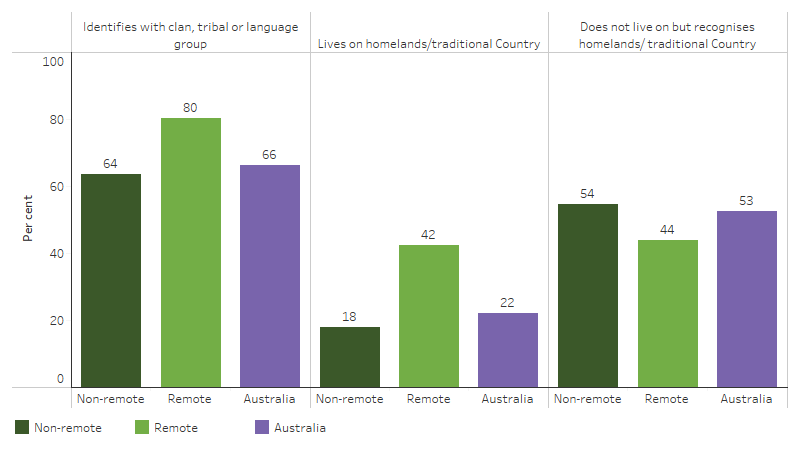
Self-reported data from the 2022–23 NATSIHS showed that an estimated 439,600 (76%) First Nations people aged 18 and over recognised an area as homelands or traditional Country. Around 1 in 5 (22% or 126,800) of First Nations adults reported they lived on their homelands or traditional Country, while over half (52% or 298,900) did not live there, however could visit (Table D2.14.1, Figure 2.14.1).
First Nations adults who lived in remote areas were more likely than those in non-remote areas to:
- identify with a clan, tribal or language group (80% or 74,400 people compared with 64% or 307,700)
- recognise an area as homelands or traditional Country (87% or 80,700 compared with 74% or 358,000)
- live on their homelands or traditional Country (42% or 39,400 compared with 18% or 87,300) (Table D2.14.1, Figure 2.14.1).
Figure 2.14.1: First Nations people aged 18 and over who identify with a clan, tribal or language group, recognise and live on homelands or traditional Country, by remoteness, 2022–23
Source: Table D2.14.1. AIHW and ABS analysis of National Aboriginal and Torres Strait Islander Health Survey 2022–23.
The proportion of First Nations adults recognising an area as homelands or traditional Country was highest in Very remote areas (89%; 51,300), and lowest in Inner regional areas (71%; 96,900). The proportion of First Nations adults living on their homelands or traditional Country was also highest in Very remote areas (50%; 29,000) and lowest in Major cities (10%; 25,300) (Table D2.14.1, Figure 2.14.2).
Figure 2.14.2: Recognition of and access to homelands or traditional Country for First Nations people aged 18 and over, by remoteness, 2022–23
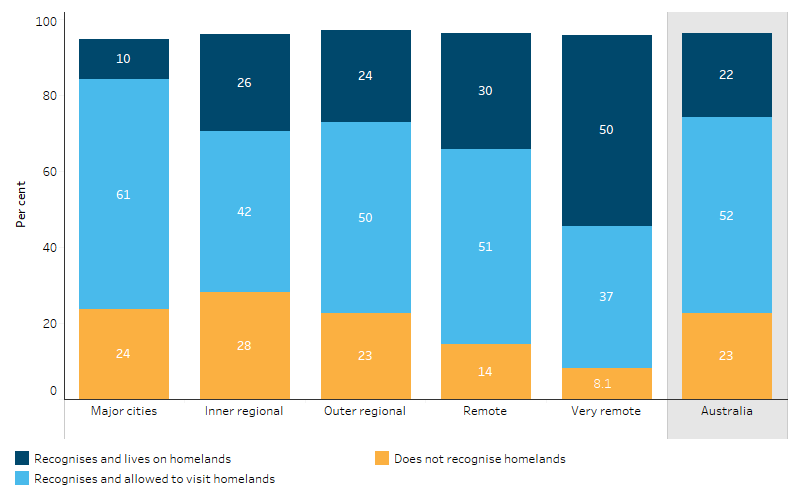
Note: Column stacks do not add to 100 because the following groups are not presented in the figure: those who recognised a homeland or traditional Country but were not allowed to visit and those who did not answer whether they recognise homelands or traditional Country.
Source: Table D2.14.1. AIHW and ABS analysis of National Aboriginal and Torres Strait Islander Health Survey 2022–23.
The Northern Territory had the highest proportion of First Nations people aged 18 and over that identified with a tribal/language group or clan (79%; 37,400), while Tasmania had the lowest reported proportion (43%; 9,400). First Nations adults living in the Northern Territory were the most likely to recognise an area as their homelands or traditional Country (86%; 40,600) and live on their homelands or traditional Country (37%; 17,200) (Table D2.14.6).
Note that the Northern Territory findings reflect the impact of the Homelands (or Outstations) movement which began over 50 years ago. A homeland is a small remote community of Aboriginal people living on lands to which they have traditional or historical ties. There are more than 500 recognised homelands in the Northern Territory (Aboriginal Housing NT n.d.).
Based on the 2022–23 NATSIHS, an estimated 13% (57,600) of First Nations adults had been removed from their family, and 45% (202,200) had relatives who had been removed from their family. Of those who recognise an area as homelands or traditional Country, 12% (43,800) had been removed from their family and 48% (172,300) had a relative who had been removed from their family. For First Nations people who did not recognise an area as their homelands or traditional Country, 15% (13,500) had been removed and 31% (29,100) had a relative who had been removed (Table D2.14.5).
In 2022–23, of First Nations people who did not currently live on their homelands or traditional Country but were allowed to visit:
- 48% (142,400) reported they visit less than once per year
- 14% (42,500) reported visiting once per year
- 16% (49,200) reported visiting several times per year
- 6.2% (18,500) reported visiting at least once a month
- 15% (45,900) reported never visiting.
Of those who visited at least once in the preceding 12 months:
- 54% (169,700) spent more than 3 months visiting
- 24% (75,300) spent less than 1 week visiting
- 19% (58,100) spent between 1 week and 1 month visiting
- 3% (9,400) spent 1 to 3 months visiting (Table D2.14.4).
Relationship with socioeconomic and health factors
Cultural determinants of health and social and emotional wellbeing are protective factors that enhance resilience, strengthen identity, and support good health and social and emotional wellbeing. These include but are not limited to connection to Country; family, kinship and community; First Nations beliefs and knowledge; cultural expression and continuity; First Nations language; and self-determination and leadership.
The 2022–23 NATSIHS provides an opportunity to analyse relationships between access to homelands and other factors. The analysis outlined below summarises simple associations found in the data; further multivariate analysis is needed to explore the complex interactions between these issues and how they relate to health outcomes. When comparing outcomes between those who recognise or live on homelands or traditional Country with those who do not, it is important to remember that these results will be significantly impacted by other factors linked with remoteness, in particular, access to amenities, health care and economic opportunity.
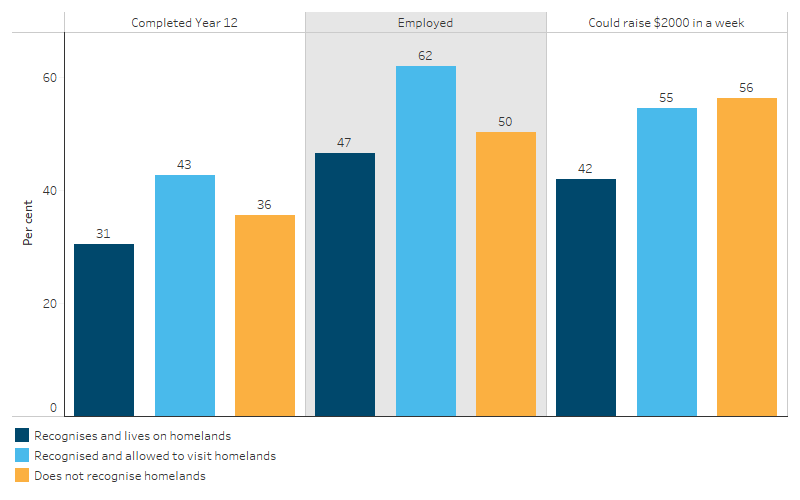
First Nations adults who lived on an area recognised as their homelands or traditional Country were less likely to have completed Year 12 (31%), less likely to be employed (47%), and less likely to be in a household able to raise $2,000 within a week (42%) than those who did not recognise an area as their homelands or traditional Country, or did but lived elsewhere (Table D2.14.2, Figure 2.14.3).
Of First Nations adults who lived in remote areas, 37% who lived on an area they recognised as homelands or traditional Country were employed, compared with 47% who did not live there but were allowed to visit. For those who lived in non-remote areas, 51% of First Nations adults who lived on an area they recognised as homelands or traditional Country were employed, compared with 64% who did not live there but were allowed to visit. In non-remote areas, 33% of First Nations adults who lived on their homelands or traditional Country had completed Year 12, compared with 46% of those who did not live there but were allowed to visit (Table D2.14.2).
These observed differences are usually linked to broader structural and historical factors and are more likely to reflect unequal access to education, employment, infrastructure, and economic opportunities – as well as the limitations of mainstream socioeconomic indicators – rather than a deficit associated with living on Country itself.
Figure 2.14.3: Proportion of First Nations people aged 18 and over by selected socioeconomic characteristics, by recognition of homelands or traditional Country and access, 2022–23
Source: Table D2.14.2. AIHW and ABS analysis of National Aboriginal and Torres Strait Islander Health Survey 2022–23.
Some cultural determinants corresponded with lower levels of psychological distress and better self-assessed health status for people aged 18 and over. For example:
- First Nations adults who felt satisfied or very satisfied with their own level of knowledge of culture were more likely to experience low or moderate levels of psychological distress in the last 4 weeks (71%) than those who were not very satisfied or not at all satisfied (61%), although the difference was not statistically significant.
- First Nations adults who did not experience themselves or their relatives being removed from their natural family were more likely to report low or moderate levels of psychological distress in the last 4 weeks (74%) than those who did (60%).
- First Nations adults who did not experience themselves or their relatives being removed from their natural family were more likely to assess themselves as being in excellent or very good health (45%) than those who did (34%), although the difference was not statistically significant.
- First Nations people whose main language spoken at home was an Aboriginal or Torres Strait Islander language were more likely to report being in excellent or very good health (44%) compared to First Nations people who mainly spoke English at home (38%), although the difference was not statistically significant (ABS 2024: Table 12.3).
Research and evaluation findings
Cultural connection as a determinant of health
Strong connections to identity, culture, and Country are consistently associated with improved health and wellbeing outcomes for First Nations people. These relationships are complex and interdependent, but consistently protective across life stages and geographies.
Evidence from the Longitudinal Study of Indigenous Children (Footprints in Time) shows that First Nations children with strong cultural connections are significantly less likely to experience social and emotional difficulties, even when facing socioeconomic disadvantage (Fatima et al. 2022). Earlier analysis found that stronger connection to Country and community was associated with improved wellbeing, though these benefits were not always captured by standard Western mental health tools (Marmor and Harley 2018). These findings align with broader research showing that cultural attachment is linked to improved mental health, resilience, and subjective wellbeing (Dockery 2011; McDermott et al. 1998; Rowley et al. 2008).
The Mayi Kuwayu Study reinforces this evidence, showing that cultural connection – particularly to Country, language, kinship, and identity – serves as a protective factor, fostering resilience and supporting improved health outcomes even in the face of adversity (Lovett et al. 2020). Further analysis found that interpersonal racism significantly impacts health and cultural participation, with everyday racial discrimination accounting for up to 47% of the gap in psychological distress between First Nations and non-Indigenous adults (Brinckley and Lovett 2022; Thurber et al. 2022).
Connection to Country and holistic wellbeing
Connection to Country is a foundational aspect of wellbeing, encompassing spiritual, physical, social, and cultural relationships with land, waters, skies, and all living things (Williamson et al. 2021). Country provides more than sustenance – it is a source of knowledge, healing, and continuity (Ganesharajah 2009). Spending time on Country strengthens cultural identity, community cohesion, and healing through language, ceremony, and place-based knowledge (Dudgeon et al. 2020; Fields et al. 2024).
The Study Away Review found that First Nations students studying away from home experience significant challenges during transition, including feelings of isolation and cultural disconnection. The review emphasised that maintaining cultural identity and connection to Country is critical for wellbeing, and that creating culturally safe environments and fostering a strong sense of belonging in educational and accommodation settings supports emotional wellbeing and academic success (PM&C 2017).
Recent evidence highlights the therapeutic value of cultural reconnection for older Aboriginal people from the Stolen Generations. Participation in sensory-led cultural camps on sacred sites fostered belonging, pride, and intergenerational healing (Yashadhana et al. 2023). Programs such as Walaay at Dharriwaa demonstrate how cultural immersion supports trauma recovery and wellbeing.
Applied examples: IPA, ILSMPs, and ranger programs
The Indigenous Protected Areas (IPA) Program and Indigenous Land and Sea Management Programs (ILSMPs) provide practical examples of how cultural connection translates into measurable outcomes. Evaluations show that living and working on Country supports emotional wellbeing, cultural pride, community relationships, employment, and skills development (Little et al. 2023; Ninti One Limited et al. 2024). These programs also contribute to biodiversity outcomes and intergenerational knowledge transfer.
ILSMPs enhance wellbeing through cultural, social, and environmental benefits. Economic activities such as hunting and fishing are deeply embedded in cultural responsibilities, and these programs contribute to resilience and cultural continuity (Jarvis et al. 2018). However, investment remains limited relative to the vast areas covered, as IPAs receive only a fraction of the funding allocated to national parks.
Complementing these evaluations, analysis from the Mayi Kuwayu Study found that Indigenous Rangers Program participation was significantly associated with high life satisfaction and family wellbeing. Maintaining connection to Country and speaking Indigenous languages mediated these associations, reinforcing the role of cultural engagement in wellbeing (Wright et al. 2021).
Caring for Country and cultural stewardship
Caring for Country is a holistic First Nations approach to land and water management, reflecting traditional laws, customs, and ways of life. It offers cultural, socio-political, economic, environmental, and health benefits (Berry et al. 2010; Weir et al. 2011). A study in central Arnhem Land found that participation in caring for Country was associated with healthier diets, greater physical activity, improved mental health, and reduced risk of chronic conditions (Burgess et al. 2009).
Programs such as Waltja Tjutangku Palyapayi and Ngurra Kujungka demonstrate how cultural knowledge and land-based activities strengthen community wellbeing. Cultural fire practices, when applied at the right time, in the right way, and by the right people, enhance biodiversity, reduce bushfire risk, and support cultural renewal (DFES 2021, 2022, 2023).
The National Recovery Plan for the Great Desert Skink (Tjakura) exemplifies Indigenous-led conservation. Through ranger-led fire management, predator control, and knowledge sharing, Traditional Owners are restoring ecological balance and cultural wellbeing (Indigenous Desert Alliance 2023).
Traditional Owner-led native food and botanical practices are deeply connected to Country and cultural identity. The Victorian Traditional Owner Native Food and Botanicals Strategy highlights how restoring Indigenous knowledge systems in land management and food production supports cultural renewal, ecological health, and economic self-determination (Federation of Victorian Traditional Owner Corporations 2021).
The Murru waaruu Economic Development Seminar Series Outcomes Report highlighted that First Nations peoples’ rights to Land and Sea Country are foundational to enabling self-determination and First Nations-led economic development. When communities manage and develop Country on their own terms through mechanisms such as cultural mapping to identify and protect cultural values, Sea Ranger programs to strengthen resource management, and land tenure reform to support sustainable use, there is potential to unlock economic opportunities and reinforce cultural authority. The report calls for a paradigm shift in policy to prioritise and enable these community-driven strategies as part of a broader framework for economic self-determination (Australian National University 2024).
Water is also central to wellbeing. The 2021 State of the Environment Report highlights that sustaining the cultural and spiritual values of water – through sufficient quantity and quality – supports many other components of First Nations life (DCCEEW 2021).
Urban and diverse pathways to connection
Living on traditional lands is not always possible, particularly for First Nations people in urban areas. However, relationships with Country are actively maintained in metropolitan contexts through practices such as community gardens with native plants, cultural education programs in schools, on-Country excursions, and urban bush regeneration projects. These activities support health and wellbeing, strengthen cultural expression, and provide opportunities for intergenerational knowledge sharing and education (Hansen and Butler 2013; Kingsley et al. 2013).
Other examples include physical return to homelands for cultural practices and ceremonies, cultural immersion through language revival, art and storytelling led by Elders, and urban-based programs that foster cultural continuity and environmental stewardship. Such approaches enable First Nations people to maintain cultural identity, enhance wellbeing and share knowledge across generations even when living away from traditional lands (Davidson et al. 2024).
Implications
Connection to Country is a foundational determinant of health and wellbeing for First Nations peoples. It encompasses spiritual, cultural, emotional, and physical dimensions, and is deeply embedded in identity, belonging, and community (Ganesharajah 2009; Gee et al. 2014). Evidence indicates that time spent on Country supports cultural continuity, strengthens identity, and contributes to improved health outcomes, including mental health and life satisfaction (Biles et al. 2024; Fatima et al. 2023).
Connection to Land or Country is also recognised as a highly protective factor for health and healing (Dudgeon et al. 2020). Tapping into this potential can play a key role in improving overall First Nations health and wellbeing and should be integrated into health strategies and service delivery. Strengthening cultural identity through connection to Country should also be embedded in health and wellbeing policies for First Nations children, as evidence from the Longitudinal Study of Indigenous Children shows that cultural identity is a protective factor against social and emotional difficulties (Fatima et al. 2022). Embedding cultural determinants including Country, language and self-determination into health and wellbeing policies, alongside reforms in water access and native title, is essential to achieving Closing the Gap outcomes and long-term equity.
The Australian Government supports First Nations-led programs that foster connection to Country, including the Indigenous Rangers Program and Indigenous Protected Areas (IPA) program. These initiatives are grounded in cultural knowledge systems and enable practical land and sea management approaches that recognise First Nations peoples’ skills and leadership (Little et al. 2023; PM&C 2016). The Australian Government is investing $1.3 billion in the Indigenous Rangers Program (2021–2028), with a goal of doubling the number of rangers by the end of the decade. In 2023, $231.5 million was allocated to expand and strengthen the IPA Program, including the establishment of 12 new Indigenous Protected Areas. Additional funding was announced in the 2025–26 Budget under the broader Saving Australia’s Bushland measure which included an additional $13 million for further IPA expansion. IPAs are areas of land and sea Country managed by First Nations groups in accordance with Traditional Owners’ objectives. IPAs deliver significant biodiversity conservation outcomes while embedding cultural knowledge and practices in environmental management. These investments reflect a long-term commitment to First Nations-led land and sea management and aligns with the National Agreement on Closing the Gap. The Indigenous Ranger Sector Strategy, yet to be finalised, will provide a guiding framework to ensure the ongoing success of a sustainable and prosperous First Nations land and sea sector. Participation in these programs has been associated with improved wellbeing, including reduced psychological distress, enhanced cultural pride, and stronger community relationships (Thurber et al. 2022; Yashadhana et al. 2023). The Mayi Kuwayu Study found a significant link between participation in land-based programs and increased life satisfaction and family wellbeing (Fatima et al. 2023; Lovett et al. 2020).
Recent evidence highlights that First Nations-led land and sea management – such as cultural fire practices, native food and botanical industries, and species recovery programs – contributes meaningfully to ecological sustainability, cultural identity, and community wellbeing. Initiatives such as the Victorian Traditional Owner Native Food and Botanicals Strategy and the National Recovery Plan for the Great Desert Skink (Tjakura) demonstrate how embedding First Nations knowledge systems in land stewardship supports biodiversity, strengthens intergenerational knowledge transfer, and promotes cultural continuity.
Scaling up First Nations-led land and sea management through initiatives such as the Indigenous Rangers Program, IPA and the forthcoming Indigenous Ranger Sector Strategy, supported by the Land, Waters, Culture and Languages Strategy 2023–2026, will strengthen cultural continuity and support sustainable employment.
Connection to Country also supports economic participation, particularly through native title rights. Native title supports cultural continuity, economic development, and self-determination (Gilbert 2015). Recognising this, approximately $170 million is available through the Indigenous Advancement Strategy in 2025–26 to support the native title sector, including to progress native title claims and to protect and leverage native title rights post-determination. This includes funding to support Native Title corporations (Prescribed Bodies Corporate, known as PBCs) to build their capacity and to take advantage of economic opportunities arising from their native title rights through the PBC Capacity Building Program.
While strong evidence supports the health benefits of connection to Country, further research is needed to understand the causal pathways linking cultural determinants to health outcomes. Much of the existing literature is based on small-scale observational studies and focuses on social and emotional wellbeing (Bourke et al. 2018). Expanding the evidence base through longitudinal, community-led research will support more effective policy design and implementation.
The Australian Law Reform Commission’s Review of the Future Acts Regime: Discussion Paper (2025) examines potential reforms to the legal framework under the Native Title Act 1993 (Cth) for activities that affect native title rights and interests. It outlines proposals to address concerns about procedural complexity, limited consultation, and the impact of future acts, such as mining, infrastructure, and water extraction, on First Nations people’s connection to land and waters. The paper presents options including Native Title Management Plans, impact-based procedural models, and revised agreement-making processes, and invites public feedback to inform its final recommendations.
The Australian Government’s First Nations Water Policy identifies a significant disparity between land and water ownership, noting that First Nations peoples hold rights to a significant proportion of Australian land through native title, yet they control less than 0.2% of surface water entitlements. To address this, the government supports initiatives such as the Murray–Darling Basin Aboriginal Water Entitlements Program (AWEP), a $100 million program dedicated to increasing First Nations ownership and management of water entitlements for cultural, social, economic, spiritual, and environmental purposes. AWEP includes strategic water purchasing, interim governance arrangements, and the development of enduring water holding models co-designed with Basin First Nations peoples.
Complementing AWEP, the Cultural Flows Planning for Cultural Economies program supports First Nations communities in the Murray-Darling Basin to articulate and plan for their spiritual, cultural, social, environmental, and economic water needs – strengthening their connection to Country and enabling future access to water entitlements.
In parallel, the Australian Government is developing a national First Nations enduring water holding model to support broader water access and governance reforms across Australia. The policy also includes a $150 million commitment through the National Water Grid Fund to improve water security in First Nations communities, with states and territories required to engage with First Nations peoples in project planning. Complementing these efforts, the Indigenous Ranger Program, including the Murray-Darling Basin Indigenous River Rangers Program, supports First Nations people to manage land and water Country using traditional knowledge and conservation science, with a $355 million investment to create 1,000 new ranger jobs nationally.
These initiatives are framed within the First Nations Strategy 2025–2030, which outlines the Department of Climate Change, Energy, the Environment and Water’s commitment to embedding First Nations perspectives, knowledge, and aspirations into all aspects of its work. The strategy’s vision is to place Country at the heart of decision-making, elevate First Nations matters across departmental planning, and strengthen cultural capability across the workforce (DCCEEW 2025).
The Committee on Aboriginal and Torres Strait Islander Water Interests (CAWI), was established in 2020 to inform water policy and reform processes across Australia. CAWI provides expert advice on the recognition and integration of First Nations peoples’ water interests – defined as cultural, spiritual, social, economic, and environmental – within national frameworks. Its work is documented in key publications including the Insights Paper: Pathway to Enduring Recognition of Aboriginal and Torres Strait Islander Peoples’ Water Interests (Committee on Aboriginal and Torres Strait Islander Water Interests 2023) and the Submission to the Australian Law Reform Commission (ALRC) Review of the Future Acts Regime (Committee on Aboriginal and Torres Strait Islander Water Interests 2025), which outline principles for reform, highlight systemic gaps in water ownership and access, and propose mechanisms to improve equity and governance in water management.
The National Agreement on Closing the Gap marks a significant shift in how governments engage with First Nations peoples. It recognises that outcomes improve when First Nations communities have a genuine voice in the design and delivery of policies and programs. Outcome Area 15 focuses on the relationship between First Nations peoples and their land and waters. This outcome area includes a target to increase the proportion of Land and Sea Country subject to First Nations legal rights or interests by 15% by 2030. These targets reflect the central role of Country in cultural, spiritual, and economic life, and highlight land rights as a foundation for wellbeing, self-determination, and intergenerational resilience.
The National Aboriginal and Torres Strait Islander Health Plan 2021–2031 highlights the importance of access to land and waters as a foundational element of health and wellbeing. It states:
Connection to Country is central to the cultural, spiritual, physical, and emotional wellbeing of Aboriginal and Torres Strait Islander people. This connection supports identity, belonging, and resilience, and is a protective factor across the life course.
The Health Plan adopts a strengths-based, holistic approach, developed in genuine partnership with First Nations people. It affirms that cultural determinants, including access to land, cultural expression, and self-determination, are essential to achieving health equity and improving life outcomes. These principles are increasingly embedded in health strategies, with the Health Plan identifying connection to Country, culture, and language as foundational to wellbeing and calling for their integration across all health policies and programs.
References
-
Aboriginal Housing NT (n.d.) Homelands, Aboriginal Housing Northern Territory website, accessed 19 May 2026.
-
ABS (Australian Bureau of Statistics) (2024) Table 12 cultural determinants of health and social and emotional wellbeing [data set], National Aboriginal and Torres Strait Islander Health Survey 2022–23, ABS website, accessed 1 April 2026.
-
Agreements Treaties and Negotiated Settlements (n.d.) Economic development and native title, Indigenous Studies Unit, The University of Melbourne ATNS website, accessed 8 April 2026.
-
AHRC (Australian Human Rights Commission) (2008) 'Indigenous peoples and water', in Native Title Report 2008, Aboriginal and Torres Strait Islander Social Justice Commissioner, AHRC.
-
AHRC (2020) Wiyi Yani U Thangani (women's voices): securing our rights, securing our future report, report prepared by A Campbell, A Stevens, A Dozer, D Dick, E Holden, J Pedersen, K Hunter, K Gray, L George, N Devereaux and S Spry, AHRC, accessed 26 March 2026.
-
AIATSIS (Australian Institute of Aboriginal and Torres Strait Islander Studies) (2022) About native title, AIATSIS website, accessed 5 June 2025.
-
Anderson P (1996) 'Priorities in Aboriginal health', in Robinson G (ed) Aboriginal Health: social and cultural transitions: proceedings of a conference at the Northern Territory university, Northern Territory University Press, Darwin.
-
Australian National University (2024) Murru waaruu (On Track) Economic development seminar series: Outcomes report.
-
Berry HL, Butler JR, Burgess CP, King UG, Tsey K, Cadet-James YL, Rigby CW and Raphael B (2010) 'Mind, body, spirit: co-benefits for mental health from climate change adaptation and caring for country in remote Aboriginal Australian communities', New South Wales Public Health Bulletin, 21(5-6):139–145, doi:10.1071/nb10030.
-
Biles BJ, Serova N, Stanbrook G, Brady B, Kingsley J, Topp SM and Yashadhana A (2024) 'What is Indigenous cultural health and wellbeing? A narrative review', The Lancet Regional Health - Western Pacific, 52:101220, doi:10.1016/j.lanwpc.2024.101220.
-
Bourke S, Wright A, Guthrie J, Russell L, Dunbar T and Lovett R (2018) 'Evidence review of Indigenous culture for health and wellbeing', The International Journal of Health, Wellness & Society, 8(4):11–27, doi:10.18848/2156-8960/CGP/v08i04/11-27.
-
Brinckley M-M and Lovett R (2022) 'Race, racism, and well-being impacts on Aboriginal and Torres Strait islander peoples in Australia', in The Oxford Handbook of Indigenous Sociology, doi:10.1093/oxfordhb/9780197528778.013.39.
-
Burgess CP, Johnston FH, Berry HL, McDonnell J, Yibarbuk D, Gunabarra C, Mileran A and Bailie RS (2009) 'Healthy country, healthy people: the relationship between Indigenous health status and "caring for country"', The Medical Journal of Australia, 190(10):567–572, doi:10.5694/j.1326-5377.2009.tb02566.x.
-
Butler TL, Anderson K, Garvey G, Cunningham J, Ratcliffe J, Tong A, Whop LJ, Cass A, Dickson M and Howard K (2019) 'Aboriginal and Torres Strait Islander people's domains of wellbeing: a comprehensive literature review', Social Science & Medicine, 233:138–157, doi:10.1016/j.socscimed.2019.06.004.
-
Committee on Aboriginal and Torres Strait Islander Water Interests (2023) Pathway to enduring recognition of Aboriginal and Torres Strait Islander Peoples’ water interests in national water reform initiatives.
-
Committee on Aboriginal and Torres Strait Islander Water Interests (2025) Submission to the Australian Law Reform Commission Review of the Future Acts Regime.
-
Commonwealth of Australia (2017) National Strategic Framework for Aboriginal and Torres Strait Islander Peoples’ Mental Health and Social and Emotional Wellbeing 2017–2023, PM&C, Australian Government, accessed 8 April 2026.
-
Davidson E, Porter L, Landau-Ward A, Wensing E, Kelly M and McNeill D (2024) Voicing First Nations Country, culture and community in urban policy, AHURI Final Report No. 430, Australian Housing and Urban Research Institute, doi:10.18408/ahuri5329001.
-
DCCEEW (Department of Climate Change, Energy, the Environment and Water) (2021) Australia state of the environment 2021: Indigenous water, DCCEEW, Australian Government.
-
DCCEEW (2025) First Nations Strategy 2025–2030, DCCEEW, Australian Government.
-
DFES (Department of Fire and Emergency Services) (2021) Cultural and contemporary fire management practices in Western Australia, DFES, Western Australian Government, accessed 20 May 2026.
-
DFES (2022) Karla Katitjin: a return to cultural burning for the Goreng-Menang Noongar Elders, DFES, Western Australian Government, accessed 20 May 2026.
-
DFES (2023) Cultural burning fact sheet, DFES, Western Australian Government, accessed 20 May 2026.
-
Dockery AM (2011) Traditional culture and the wellbeing of Indigenous Australians: An analysis of the 2008 NATSISS, Centre for Labour Market Research, Curtin University, accessed 20 May 2026.
-
Dudgeon P, Bray A, Smallwood G, Walker R and Dalton T (2020) Wellbeing and healing through connection and culture, Lifeline Australia, accessed 20 May 2026, doi:10.6084/m9.figshare.14036774.
-
Dudgeon P, Calma T, Brideson T and Holland C (2016) 'The Gayaa Dhuwi (Proud Spirit) Declaration–a call to action for Aboriginal and Torres Strait Islander leadership in the Australian mental health system', Advances in Mental Health, 14(2):126–139, doi:10.1080/18387357.2016.1198233.
-
Fatima Y, Cleary A, King S, Solomon S, McDaid L, Hasan MM, Al Mamun A and Baxter J (2022) 'Cultural Identity and Social and Emotional Wellbeing in Aboriginal and Torres Strait Islander Children', in Baxter J, Lam J, Povey J, Lee R and Zubrick SR (eds) Family Dynamics over the Life Course: Foundations, Turning Points and Outcomes, Springer International Publishing, Cham, doi:10.1007/978-3-031-12224-8_4.
-
Fatima Y, Liu Y, Cleary A, Dean J, Smith V, King S and Solomon S (2023) 'Connecting the health of country with the health of people: application of "caring for country" in improving the social and emotional well-being of Indigenous people in Australia and New Zealand', The Lancet Regional Health – Western Pacific, 31, doi:10.1016/j.lanwpc.2022.100648.
-
Federation of Victorian Traditional Owner Corporations (2021) Victorian Traditional Owner Native Food and Botanicals Strategy, Federation of Victorian Traditional Owner Corporations.
-
Fields T, Foster W, Biles BJ and Yashadhana A (2024) 'Redefining the gap in Aboriginal health: from deficit to cultural connection', The Lancet Regional Health – Western Pacific, 52, doi:10.1016/j.lanwpc.2024.101176.
-
Ganesharajah C (2009) Indigenous health and wellbeing: the importance of country, AIATSIS, accessed 20 May 2026.
-
Gee G, Dudgeon P, Schultz C, Hart A and Kelly K (2014) 'Aboriginal and Torres Strait Islander social and emotional wellbeing', in Dudgeon P, Milroy H and Walker R (eds) Working together: Aboriginal and Torres Strait Islander mental health and wellbeing principles and practice, Telethon Institute for Child Health Research/Kulunga Research Network, University of Western Australia, PM&C.
-
Gilbert R (2015) Connection to Country: review of the Native Title Act, AIATSIS, accessed 20 May 2026.
-
Green JH and Moggridge BJ (2021) Inland water: Indigenous water, Australia State of the environment 2021, Australian Government Department of Agriculture, Water and the Environment, doi:10.26194/0P6K-MS94.
-
Hansen C and Butler K (2013) Exploring urban identities and histories, AIATSIS.
-
Indigenous Desert Alliance (2023) National Recovery Plan for the Great Desert Skink (Liopholis kintorei), DCCEEW, Australian Government.
-
Jarvis D, Stoeckl N, Addison J, Larson S, Hill R, Pert P and Lui FW (2018) 'Are Indigenous land and sea management programs a pathway to Indigenous economic independence?', The Rangeland Journal, 40(4):415–429, doi:10.1071/RJ18051.
-
Kingsley J, Townsend M, Henderson-Wilson C and Bolam B (2013) 'Developing an exploratory framework linking Australian Aboriginal peoples’ connection to country and concepts of wellbeing', International Journal of Environmental Research and Public Health, 10(2):678–698, doi:10.3390/ijerph10020678.
-
Little R, Lyons P, Woodward E, Jarvis D, Abbott T, Hill R, Maloney K, Braedon P, Reeve R and Bubb A (2023) Indigenous Protected Areas (IPA) Program evaluation final evaluation report, NIAA.
-
Lovett R, Brinckley M-M, Phillips B, Chapman J, Thurber KA, Jones R, Banks E, Dunbar T, Olsen A and Wenitong M (2020) 'Marrathalpu mayingku ngiya kiyi. Minyawaa ngiyani yata punmalaka; wangaaypu kirrampili kara [Ngiyampaa title]; In the beginning it was our people's law. What makes us well; to never be sick. Cohort profile of Mayi Kuwayu: The National Study of Aboriginal and Torres Strait Islander Wellbeing [English title]', Australian Aboriginal Studies, (2):8–30.
-
Marmor A and Harley D (2018) 'What promotes social and emotional wellbeing in Aboriginal and Torres Strait Islander children?: Lessons in measurement from the Longitudinal Study of Indigenous Children', Family Matters, (100):4–18.
-
McDermott R, O'Dea K, Rowley K, Knight S and Burgess P (1998) 'Beneficial impact of the homelands movement on health outcomes in central Australian aborigines', Australian and New Zealand Journal of Public Health, 22(6):653–658, doi:10.1111/j.1467-842x.1998.tb01464.x.
-
National Native Title Tribunal (2011) Developing Indigenous Land Use Agreements: a guide for local government, National Native Title Tribunal, Australian Government.
-
Ninti One Limited, CSIRO and James Cook University (2024) Indigenous Protected Areas Program evaluation: community report, NIAA, Australian Government.
-
PM&C (Department of Prime Minister and Cabinet) (2016) Reporting back...2014-15: how Indigenous Ranger and Indigenous Protected Areas programmes are working on country, PM&C, Australian Government.
-
PM&C (2017) Study Away Review: review of support for Aboriginal and Torres Strait Islander secondary students studying away from home, PM&C, Australian Government, accessed 20 May 2026.
-
Productivity Commission (n.d.) Socio-economic outcome area 15 - Aboriginal and Torres Strait Islander people maintain a distinctive cultural, spiritual, physical and economic relationship with their land and waters, Closing the Gap Information Repository website, accessed 20 May 2026.
-
Rowley K, O'Dea K, Anderson I, McDermott R, Saraswati K, Tilmouth R, Roberts I, Fitz J, Wang Z, Jenkins A, Best J, Wang Z and Brown A (2008) 'Lower than expected morbidity and mortality for an Australian Aboriginal population: 10-year follow-up in a decentralised community', The Medical Journal of Australia, 188(5):283–287, doi:10.5694/j.1326-5377.2008.tb01621.x.
-
Schultz R and Cairney S (2017) 'Caring for country and the health of Aboriginal and Torres Strait Islander Australians', The Medical Journal of Australia, 207(1):8–10, doi:10.5694/mja16.00687.
-
Thurber KA, Brinckley M-M, Jones R, Evans O, Nichols K, Priest N, Williams DR, Gee GC, Joshy G, Banks E, Thandrayen J, Baffour B, Mohamed J, Calma T and Lovett R (2022) 'Population-level contribution of interpersonal discrimination to psychological distress among Australian Aboriginal and Torres Strait Islander adults, and to Indigenous–non-Indigenous inequities: cross-sectional analysis of a community-controlled First Nations cohort study', The Lancet, 400(10368):2084–2094, doi:10.1016/S0140-6736(22)01639-7.
-
Weir JK (2012) Country, native title and ecology, Australian National University Press, Canberra.
-
Weir S, Youngentob K and Youngetob K (2011) The benefits associated with caring for country, report to the Australian Government Department of Sustainability, Environment, Water, Population and Communities, AIATSIS, accessed 20 May 2026.
-
Williamson L, Dent P and Bowman N (2021) Culture is key: towards cultural determinants-driven health policy – final report, Lowitja Institute, doi:10.48455/k9vd-zp46.
-
Wright A, Yap M, Jones R, Richardson A, Davis V and Lovett R (2021) 'Examining the associations between Indigenous rangers, culture and wellbeing in Australia, 2018–2020', International Journal of Environmental Research and Public Health, 18(6), doi: 10.3390/ijerph18063053.
-
Yashadhana A, Biles BJ, Serova N, Topp SM, Kingsley J, Zwi AB, Fields T, Foster W, O’Leary M, Brady B, de Leeuw E and Raven M (2024) 'Gaawaadhi Gadudha: exploring how cultural camps support health and wellbeing among Aboriginal adults in New South Wales Australia, a qualitative study', The Lancet Regional Health – Western Pacific, 52:101208, doi:10.1016/j.lanwpc.2024.101208.
-
Yashadhana A, Fields T, Liu E, Serova N, O'Leary M, Kenning G, Kuchelmeister V, Lockhart J and de Leeuw E (2023) 'Therapeutic aspects of Connection to Country and cultural landscapes among Aboriginal peoples from the Stolen Generations living in urban NSW, Australia', Public Health Research & Practice, 33:e3342332, doi:10.17061/phrp3342332.
-
Zubrick S, Shepherd C, Dudgeon P, Gee G, Paradies Y, Scrine C and Walker R (2014) 'Social determinants of social and emotional wellbeing', in Dudgeon P, Milroy H and Walker R (eds) Working together: Aboriginal and Torres Strait Islander mental health and wellbeing principles and practice, report to the Australian Government Department of Prime Minister and Cabinet, Kulunga Aboriginal Research Development Unit, The Kids Research Institute Australia, The University of Western Australia, Canberra.